Cette publication est également disponible en :
 Français

Speech by Eyal Davidson
Colloquium The Kabbalah of Safed
The Golden Age of Safed
Over a period of around 40 years, in the 16th century. The town of Safed became the center of the Jewish world, undergoing a spiritual and intellectual revolution without historical precedent.
In this discussion, Dr. Eyal Davidson explores the remarkable growth of Safed in the 16th century, highlighting its significant influence on Jewish thought, law and customs. He attributes this rise to two major historical events: the expulsion of Jews from Spain in 1492 and the Ottoman conquest of the region in 1517. Safed, despite its lack of natural resources or rich historical baggage, has become a center of Jewish scholarship and spirituality, particularly through the works of such luminaries as Rabbi Yosef Karo and Kabbalist Ari Zal.
Eyal Davidson’s lecture moderated by Michael Sebban.
Safed’s blossoming in the 16th century: a historical and cultural analysis
The 16th century marked a pivotal period in Jewish history, particularly in the context of the town of Safed (Tzfat) in Israel’s Galilee region. This period saw an unprecedented growth in Jewish scholarship, spirituality and communal life, largely influenced by the expulsion of Jews from Spain and the subsequent Ottoman conquest of the region. The convergence of these historical events catalyzed the transformation of Safed into a center of Jewish thought and mysticism, shaping the religious landscape of Judaism for centuries to come. This essay explores the key themes and arguments surrounding the rise of Safed during this period, focusing on socio-economic conditions, the impact of Kabbalistic thought and the importance of Jewish identity and messianic expectations.
The expulsion of Jews from Spain in 1492 serves as a critical backdrop to Safed’s development. After their expulsion, many Jews sought refuge in the Ottoman Empire, which was perceived as a more tolerant environment than the Christian-dominated regions. The influx of Spanish Jews, particularly those with rich cultural and intellectual backgrounds, greatly enriched Safed’s local Jewish community. This migration brought not only a wealth of knowledge and traditions, but also a sense of urgency about preserving and revitalizing Jewish identity in the face of adversity. Safed’s socio-economic conditions, characterized by relative stability and a booming textile industry, provided fertile ground for this cultural renaissance. The town’s strategic location as a commercial hub facilitated trade and interaction, enabling the exchange of ideas and resources that would stimulate its growth.
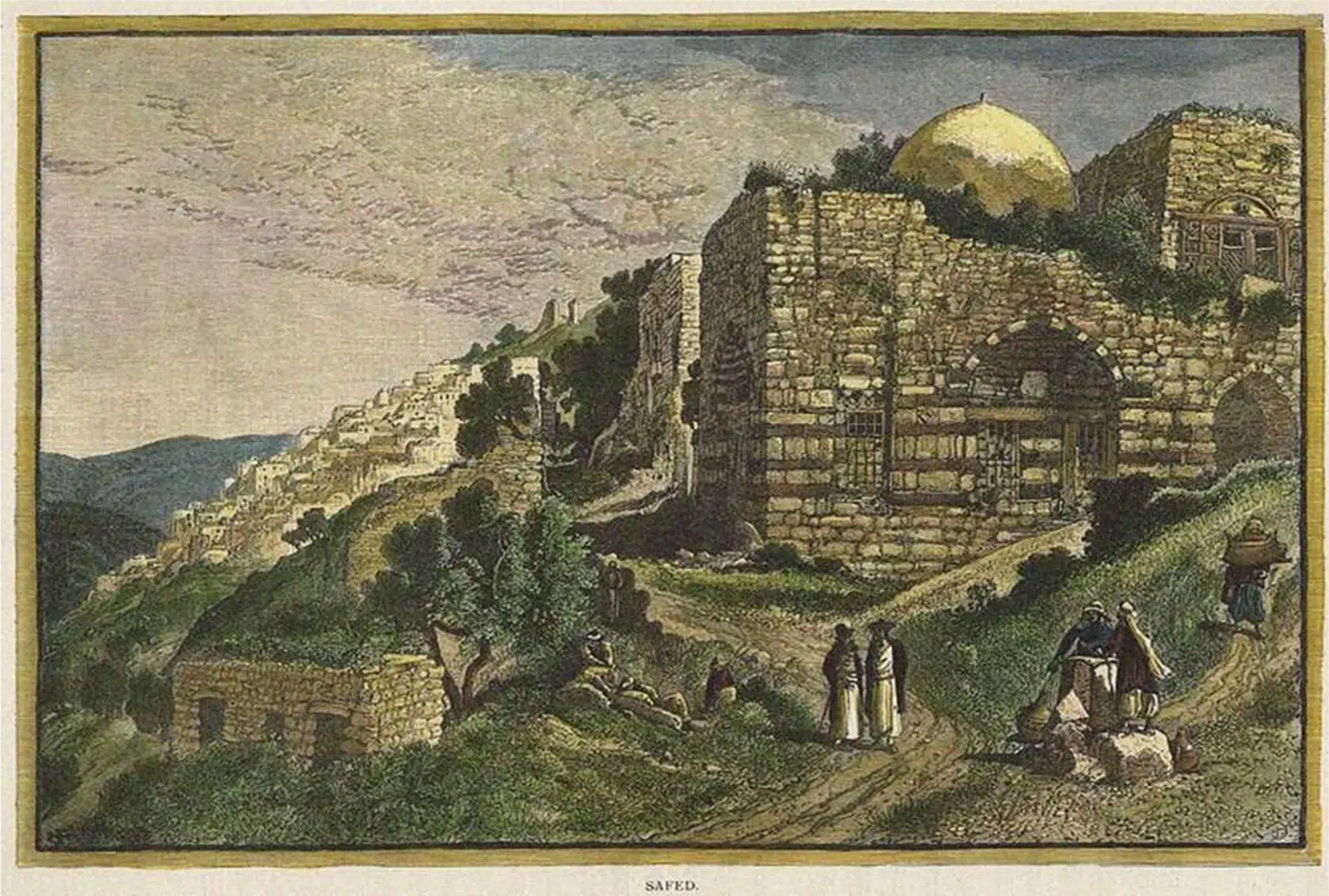
Safed lies in the Upper Galilee, north of the land of Naphtali; the town is firmly anchored to the summit of its mountain range, which is surrounded by four other mountains, two of which are entirely inhabited by Ishmaelites and the other two by Jews on all sides. There are three hundred Jewish homes and three synagogues, one serving the Sephardic rite, another the Morisco rite and the third the Maugrabi rite1. The latter is dedicated to the memory of the prophet Elijah, of blessed memory, due to its antiquity and the local tradition that relates that Elijah prayed there.
The city abounds with all the finest products; the finest foodstuffs are available in abundance, such as wheat, wine, and olive oil, are available at the most reasonable prices for those who purchase them at their peak, in season; and were it not for the export to Damascus of most of the oil and grain from the surrounding area, everything there would be free. Beautiful fruits of all kinds are also found there, so that there is no need to import any from Syria. The region also provides an abundance of goods for retailers in woolen clothing, haberdashery, and perfumery. Many of these shops are run by Jews, who import their raw materials from Damascus to sell them in Safed. In every season, the residents stock up on clothing and other goods. Numerous Jewish peddlers of haberdashery and other supplies crisscross the surrounding villages, whose own homes are filled with these goods and fine merchandise. There is [indeed] a particular advantage in stockpiling raw cotton, thread, wax, and [products derived] from scammony when prices are low and selling them when demand is high.
Other Jews sell fruits and vegetables, oil, and cheese, as well as other foodstuffs, at retail. All it takes is the will to start trading in grain, wine, and olive oil, no matter the era.
In general, the country was even more conducive to trade than Italy, as Ishmaelites were more inclined to buy from Jews than from other traders.
If you don’t have the support to start a business, you must become a craftsman. In the Land of Israel, there are four suitable crafts: weaving, goldsmithing, inns and tanning. To these we can add construction. Anyone with the strength to work as a day laborer in one of these professions will be besieged by favorable solicitations. Tailors also earn their living here.
But no one will be able to find employment as a tutor, servant or store assistant, nor to beg for public charity, as the poor are in great numbers. Also, no one should leave Italy if he or she has neither a craft nor the funds to set up a business, lest they fall prey to bitter disappointment and be forced to return. Good luck.
Letter from Rabbi Moshe Bassoula (1523)
, quoted by [Alef] Ya’ari in *Travels in the Land of Israel*. Tel Aviv 1996, pp. 138–139. (Translation by Erez Lévy)
At the heart of Safed’s identity during this period was the emergence of Kabbalistic thought, which became a defining feature of its spiritual landscape. The arrival of eminent kabbalists, such as Rabbi Isaac Luria (the Ari), transformed Safed into a center of mystical study and practice. Luria’s teachings emphasized the importance of spiritual elevation and world rectification (Tikkun Olam), resonating deeply with the collective trauma of the Jewish community following the expulsion. The Kabbalistic framework provided a means of understanding their suffering and a path to redemption, reinforcing the belief that their trials were part of a divine plan. This spiritual awakening was not simply an intellectual exercise; it was intimately linked to the daily life of the community, influencing the rituals, customs and general ethos of Safed.
The theme of Messianic expectation also played a crucial role in shaping the identity of Safed’s Jewish community. The historical context of the expulsion and subsequent migration to Safed fostered a heightened sense of urgency regarding the coming of the Messiah. Many Jews believed that their suffering was a precursor to redemption, and Safed emerged as a focal point for these aspirations. The belief that the Messiah would first reveal himself in Galilee, rather than in Jerusalem, further reinforced Safed’s importance. This expectation was not only a reflection of religious fervor, but also a response to the socio-political realities of the time. The community’s collective hope of redemption provided a unifying force, fostering resilience and solidarity among its members.
Rabbi Eliahu Kipschali
We thought the expulsion was a calamity, but God saw it as a blessing. For who knows if in that hour we didn’t gain access to royaule, and if that wasn’t the beginning of our salvation. For we have been gathered by the One who gathers the outcasts of Israel, so that we ourselves might be ready to gather the exiles. So this expulsion, which manifested itself to us as a calamity of darkness, would herald the seed of salvation. For from that day on, the Lord began to gather the outcasts of our people, so that they would be prepared and destined in one place for the coming of the Redeemer. So the sufferings endured by the Jews at that time are a response to the words of one of our prophets: “The end is come, near is the coming of the Redeemer, the days of His presence will delay no longer. For as soon as He was expelled from Spain, He began to gather the outcasts of Israel from the four wings of the earth. Amen, so be it.”
Excerpt from Ben Schoschan: Exile and Redemption as perceived by the expellees from Spain.
In Ettinger et alli (eds.) Mélanges en l’honneur d’Its’haq Ber. Jerusalem, 1962, pp. 226-227. (Translation by Erez Lévy)
However, Safed’s rapid rise was accompanied by an equally rapid decline. The economic stability that had sustained its growth began to falter in the late 16th century, leading to a decline in population and influence. The collapse of the textile industry, combined with political instability and external pressures, contributed to this slowdown. The once thriving center of Jewish thought and mysticism became a shadow of its former self, illustrating the fragility of cultural and intellectual movements in the face of economic and political challenges. This decline raises important questions about the durability of cultural centers and the factors that contribute to their rise and fall.
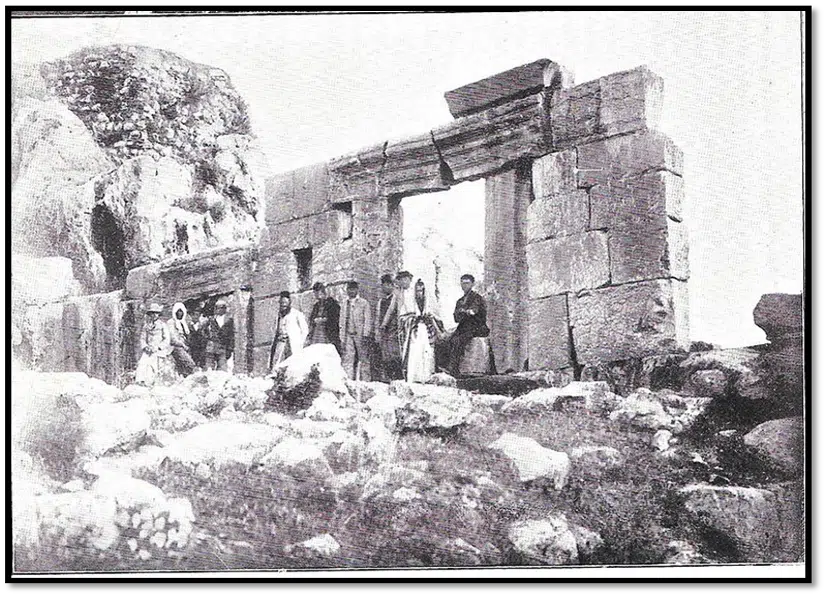
Ancient synagogue on Mount Meron (before 1899)
As soon as you enter Sapita, near the Jewish quarter, you can see the tomb of Hoshea ben Beri, the prophet of blessed memory, which bears neither stele nor inscription, but only a large stone placed over the opening of the burial pit. As soon as I arrived in the city, I went to this tomb.
Six miles from Sapita lies a village called Alyaroune, where some of the holy men whose names I shall mention were buried. Before reaching it, on the side of the road, I saw three graves. The first was that of Rabbi Yehuda Hanescht, may his holy memory be a source of blessing, on which the memorial stones were few in number. Not far from it is the beautifully decorated tomb of Rabbi Tarphon, may his holy memory be a source of blessing. Continuing along the path, we came across the tomb of Rabbi Yosseph ben Kisma, may his holy memory be a source of blessing, which was also covered only by a heap of stones and devoid of inscriptions. We finally reached the village of Alyaroune, where we could see the cave of Rabbi Hillel and his disciples, may their holy memory be a source of blessing, who, numbering twenty-four, are buried next to their master.
Then we entered an adjoining cave where twenty-four distinguished students are buried; it is said that they were disciples of Rabbi Shimon bar Yochai in Acre, for near this spot, on the mountainside, stands a stele of infinite beauty, visible as far as Sapita; it is also there that their wives were buried, though there are no inscriptions in their memory on these graves. It was said that many prayers had been offered for the deceased women at this site, upon which, it is said, devastation struck one night—but I do not know if these accounts are true. I then discovered the tomb of Rabbi Shammai and his wife, may their holy memory be a source of blessing, buried beneath a single, large stone—the like of which I had never seen before—and beneath which lies the cave where the disciples of Shammai were buried, may their holy memory be a source of blessing.
I also saw the site [where Rabbi Shimon bar Yochai rests], which is likewise a structure built of tall stones. But [this monument] is now in ruins; only one of its surrounding walls remains. The people of Sapita claim to have received this revelation: namely, that [the day] this last surrounding wall collapses will be the day of the coming of our Messiah—may He reveal Himself without delay and in our lifetime. I was told that in the very year of the expulsion from Spain, a [portion] of the wall began to crumble, which the inhabitants of Sapita saw as a sign that they honored with a day of feasting and rejoicing.
Excerpt from Letters from an Anonymous Traveler Sent from Jerusalem to Italy in the Year 5656 (1896–1897), cited by (Alef) David: For the Salvation of Jerusalem, published in 5763 (2003–2004), pp. 156–157. (translation by Érez Lévy)