Cette publication est également disponible en :
 Français
At the end of his major work, the thirteenth-century kabbalist Abraham Aboulafia presents the method of Tserouf, the true foundation of his teaching. Yet the method appears deceptively simple. It took a combinatorics paper published in 1984 to reveal the mathematical power hidden in this ordering.
Tserouf
In The Light of the Intellect, Abraham Aboulafia, a thirteenth-century kabbalist and an avid reader of The Guide for the Perplexed, develops a bold thesis: because language and the cosmos obey the same fundamental principle, human beings can approach the divine through the manipulation of letters.
Contrary to what is often said, the secret of prophecy does not lie in the letters themselves but in the mechanical practice of arranging them. Aboulafia calls this practice Tserouf, the methodical permutation of letters. For it to work, however, Tserouf must be practiced and mastered according to a very precise method.
He introduces his method as follows:
| This rule is easy to understand, and although it has no end that we can apprehend, it necessarily has an end. […] | זה הכלל הוא קל להבינו ואף על פי שאין לו סוף מושג לנו אבל יש לו סוף בהכרח […] |
| And this is why all its parts are included in its general name, which is the Tserouf of the letters; it is also called the reversal of the letters, for all is one. […] | ועל כן כל חלקיה נכללו בשמה הכללי והוא שם צירוף האותיות או נקראה הפוך האותיות שהכל אחד […] |
| And this is why the letters were set in rotation, front and back, as it is written in the Sefer Yetsirah | ועל כן התגלגלו האותיות בפנים ואחור כמו שכתוב בספר יצירה. |
He then asks us first to master the Tserouf of two letters:
AB BA
Then, for three letters, the six arrangements must be listed in this order:
ABC ACB BCA BAC CAB CBA
He establishes this order so that:
- The last word, CBA, is the reversal of the first, ABC
- The first letter remains fixed for as long as possible
He does not explicitly explain why, unlike alphabetical order, BCA must come before BAC.
For a four-letter word, there are 24 possible arrangements, and they must be listed according to the following four block headings:
The block beginning with A, followed by the six permutations of BCD
The block beginning with B, followed by the six permutations of CDA
The block beginning with C, followed by the six permutations of DAB
The block beginning with D, followed by the six permutations of ABC
His method seems so simple to him that he does not even bother to provide the full list of 24 permutations. He simply gives the following general recursive rule:
- Keep the first letter fixed and perform the Tserouf on the last three letters
- Return to the beginning of the block
- Rotate the word by moving the first letter to the end
Aboulafia guarantees that if this method is applied, no error will be made regardless of the number of letters.
Indeed, applying his method to a five-letter word produces the following five block headings:
The block beginning with A, followed by the 24 permutations of BCDE
The block beginning with B, followed by the 24 permutations of CDEA
The block beginning with C, followed by the 24 permutations of DEAB
The block beginning with D, followed by the 24 permutations of EABC
The block beginning with E, followed by the 24 permutations of ABCD
Reading this text, I asked myself the following questions:
- Why does he speak of a “reversal of the letters” when the letters are being rotated?
- What exactly does he mean by “set in rotation, front and back”?
- Why does he not explicitly explain why BCA comes before BAC?
- Is it the order of the permutations that opens the way to prophecy, or simply the idea of permutation itself?
- Given the many algorithms now available for generating permutations, what makes Aboulafia’s order special?
Surprisingly, modern mathematics and computer science allow us to answer these questions and understand why mastering the order of Tserouf is so fundamental to Kabbalah.
Suffix reversals
In 1984, mathematician Shmuel Zaks published a short paper on algorithms for generating permutations, entitled A New Algorithm for Generation of Permutations.
In his paper, Zaks gives a simple, efficient, and elegant procedure for generating every permutation of a word using only one operation: a suffix reversal, that is, reversing the order of the final letters of the word.
The lengths of the suffixes to reverse follow an easy-to-remember rhythm:
232324
232324
232324
23232
Zaks’s deceptively simple procedure attracted the attention of mathematicians, who studied an object known as the Pancake Graph. In this graph,
- the vertices are all possible arrangements of a word with n letters
- the edges connect vertices that differ only by a suffix reversal
This graph has remarkable properties that are especially interesting in network theory:
- self-similarity
- maximum fault tolerance
More surprisingly still, Zaks’s procedure generates precisely Aboulafia’s order.
- Reversing the last two letters of ABCD gives ABDC
- Reversing the last three letters of ABDC gives ACDB
- and so on…

A single operation is used: reversal. This answers the first question: Tserouf is a sequence of partial reversals that eventually leads to the complete reversal of the word.
There are many algorithms for enumerating all permutations of a word, but none is as simple and elegant as Zaks’s.
But there is more…
The symmetry of the world
Computer science allows us to draw the structure of Tserouf by visualizing the Pancake Graph in Aboulafia’s order using Zaks’s formula.
Each word is placed at equal intervals around a circle in Aboulafia’s order, and each word is connected to its mirror image.
For four letters, we obtain the following graph:

For six letters:

So far, nothing very surprising. But when we draw the graph for seven letters, something happens.
Take a moment to look at it…
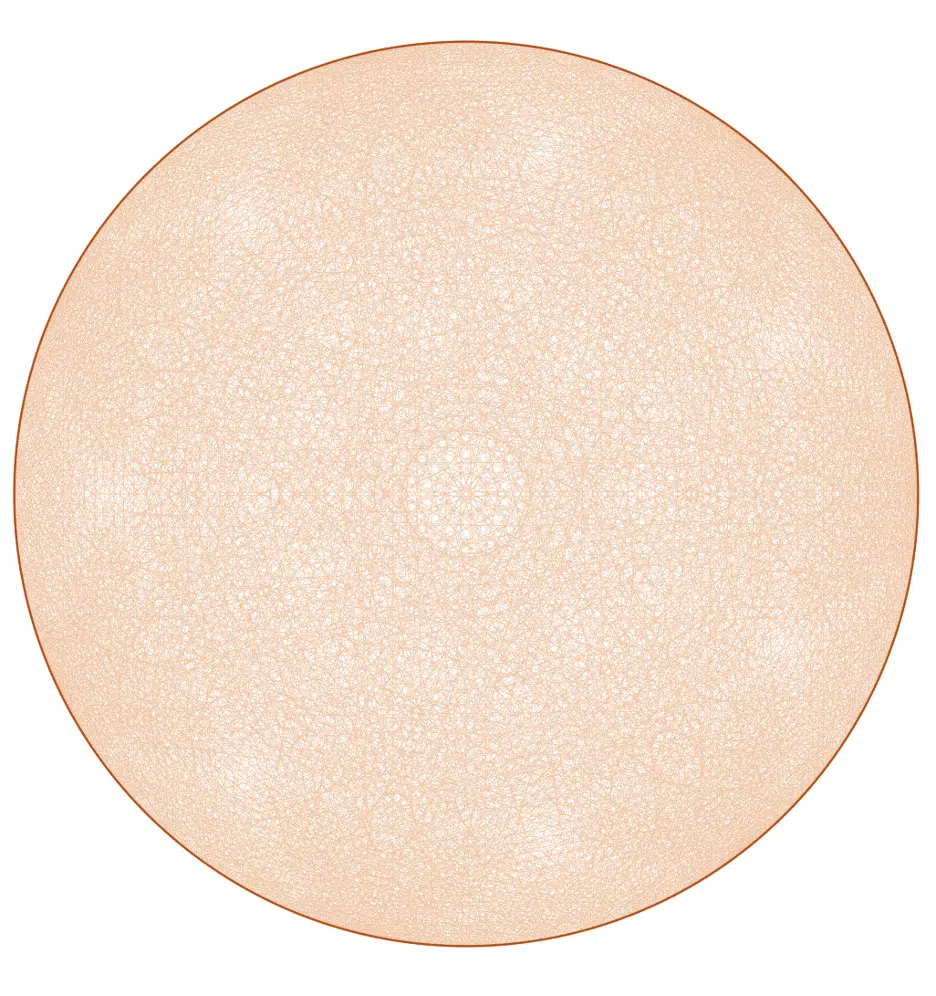
Rounded patterns seem to emerge from a graph made entirely of straight lines.
This does not occur with the other known permutation-generation algorithms considered here. It is a distinctive property of Aboulafia’s order.
With the help of a mathematician friend, we were able to prove this formally in a paper published in July 2026.
The chords of the graph seem to point in chaotic directions, yet they organize themselves according to a dihedral symmetry: precisely the symmetry of a regular polygon with as many vertices as the Tserouf has letters. In other words, the graph can be rotated by one seventh of a turn without changing, and when reflected in a mirror it remains invariant.
This seems to capture precisely the meaning of the introductory phrase about Tserouf: “the letters were set in rotation, front and back.”
And this is not trivial, because the same kind of dihedral symmetry appears throughout the natural world.


Since the nineteenth century, one device has made dihedral symmetry visible: the kaleidoscope.
Its name tells us what it does:
- καλός (kalos) — beauty,
- εἶδος (eidos) — form
- σκοπεῖν (skopein) — to look
A kaleidoscope is an instrument for looking at beautiful forms. The secret of their beauty is dihedral symmetry, created by an arrangement of mirrors that repeatedly reverse a pattern according to a simple but precise method.
This symmetry has the power to transform any pattern into a harmonious form.
The mirrors reverse the pattern again and again, just as Tserouf reverses the letters.
Aboulafia can thus be seen as having constructed a literary kaleidoscope centuries ahead of its time. In his teaching, this practice is linked to access to prophecy, and he provides the method for reconstructing it.