
Cette publication est également disponible en :
 Français
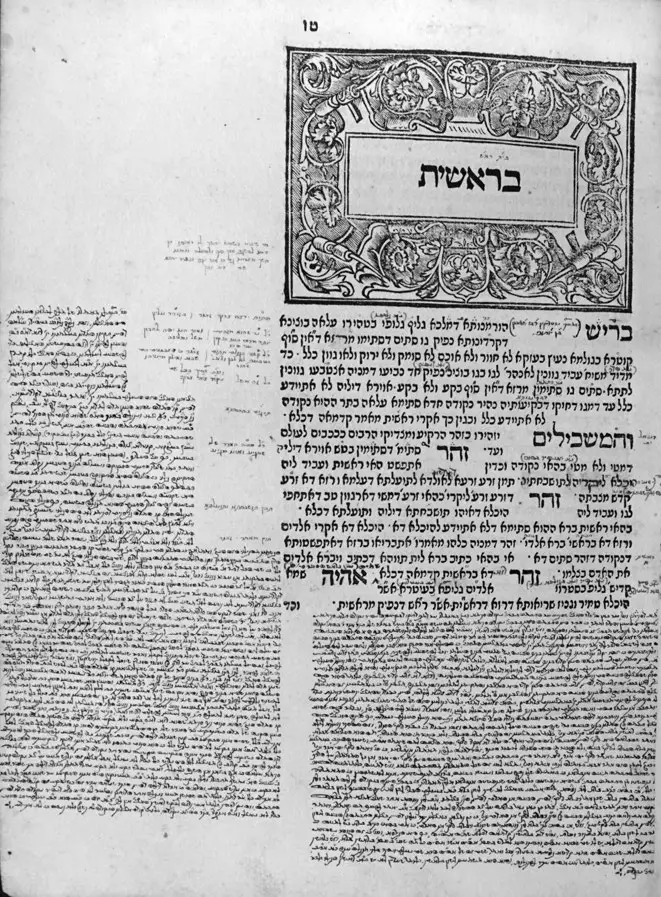
The issue of the printing of the Zohar in the 16th century is complex. The success of Italian printers in simultaneously producing two printed editions thwartedother ongoing and future manuscript projects of the Zohar and forced the Kabbalists of Safed and their students to adapt and respond to the printed version as a canonical text rather than produce an alternative work intended for widespread consumption. For the study of the Zohar and the critical engagement with the detailed examination of the multiple versions found in the manuscript, the timing of the printing and all that is specific to these editions suggest that the printing of the Zohar was a tragedy. The printing of the Zohar texts beginning in 1557 forced the Kabbalists to deviate from their established path in their study of the Zohar—particularly with regard to the manuscript variants—and, in many respects, they never fully recovered from this. This characterization of the tragedy is based on a value judgment made with the benefit of hindsight from the historical study of Kabbalah and on an assessment of the critical value of the textual scholarship undertaken by these Kabbalists.
I contend that certain editorial works on the Zohar were never completed or published because of what the printed edition offered. Some editions were printed hundreds of years later, precisely because a different textual version had gained prominence and become canonical. Moreover, the Mantua text was both different and artificial as a standardized text. The Kabbalists of Safed were compelled to respond to what they knew to be an inferior text compared to the manuscripts and other edited texts in their possession. Their textual-critical work in response to the printing added another layer of complexity. Many projects were never completed. They would have reinvented the form of the Zohar and established a new edited version. Suffice it to say that it is not a stretch of the imagination to suggest that Cordovero’s magnum opus, *Or Yaqar*, was not printed due to the widespread acceptance of the Mantua edition. Given the immediate success of the Mantua edition in Safed and other major reading communities, no scribe or Kabbalist bothered to extract the edited text of the Zohar from his voluminous work, *Or Yaqar*. It should be noted that Cordovero’s text was organized differently and based on other manuscripts; therefore, regardless of its value—both at the time and today—for modern Kabbalists and scholars, it has become functionally irrelevant to most readers, who have relied solely on printed editions. Furthermore, given the commercial success of its distribution in Italy and the Land of Israel—where Lurianic Kabbalah took root in the 16th and 17th centuries— the Cremona edition—which enjoyed great success in Ashkenaz and Eastern Europe—lost much of its influence over the majority of Kabbalists for generations to come. In short, if the Mantua edition had been produced later or had not been printed at all, the Zohar’s trajectory would have taken a different course. It is clear that there has never been a single version of the Zohar; thus, the success of this single edition has obscured the complexity of earlier periods. It is the history of the study of the Zohar texts before and after the Mantua edition that will provide the context for evaluating this edition. 1For more on the history of the publication of the Zohar, see Gershom Scholem, *Bibliographia Kabbalistica*, Leipzig 1927, pp. 166–184; Meir Benayahu, *Hebrew Printing at Cremona*, Jerusalem 1971, pp. 121–137; Marvin J. Heller, *The Sixteenth-Century Hebrew Book: An Abridged Thesaurus*, Leiden 2004, pp. 461 [*Tiqqune Zohar*] 485 [Zohar Mantua] 503 [Zohar Cremona]; Jan Doktór, “Sefer haZohar: the Battle for Editio Princeps,” Jewish History Quarterly (Kwartalnik Historii Żydów) 2 (2012), pp. 141–161; Moshe Idel, “Printing Kabbalah in Sixteenth-Century Italy,” *Jewish Culture in Early Modern Europe: Essays in Honor of David B. Ruderman*, ed. R. I. Cohen, N. B. Dohrmann, A. Shear, and E. Reiner, Pittsburgh 2014, pp. 85–96. .
The Zohar’s success prior to the 16th century can be attributed in large part to the absence of any stable, clearly defined literary form, which allowed its texts to circulate in various versions and configurations. This only served to reinforce the air of mystery surrounding this supposedly ancient work, just as it established an expected practice for its use: the textual performance of collecting and editing its parts. Although the books of the Zohar were written in the late 13th century, many other Zoharic texts were also composed within a short period of time, producing a family of texts and works that posed a challenge to later copyists and editors who sought to bring together various sources in a single physical location—a process that has only recently been accomplished in a single volume 2I am referring to the 2013 edition (later reprinted with additional indexes and notes) of Sefer ha-Zohar Mennuqad she-hibber ha-Tanna ha-Eloqi R. Shimon bar Yohai, zechuto yagen ‘aleinu (np sd). Not only does this single volume include Tiqqune Zohar , Zohar ‘al ha – Torah , and Zohar Hadash , but the Hashmatot and Tosafot have been moved from the end of each of the three volumes and inserted into the various pericopes of the Torah commentary. . However, this literary phenomenon also presented a wealth of opportunities for interpretation within this corpus and provided further impetus for later anthologists and printers to select these texts and compile the works that would be printed in book form.
The dynamic nature of the early history or career of the Zoharic texts is what necessitated decisive action in editorial practice in a later period. Sixteenth-century printers thus created the Tiqqune Zohar and Sefer ha – Zohar ‘Al ha-Torah as the books we know today, since nothing similar existed in this form in previous centuries. But these books are works of art, and the texts deemed works of art, in order to be printed as books, had already taken shape in the sixteenth century in several regions and by numerous figures for various reasons. Their eventual printing was inevitable and not solely the work of a single printer, even though two Italian printing houses were simultaneously vying to be the first to achieve this in the 1550s. Perhaps we could speak more accurately of the super-redundancy of the practical redaction of the Zohar in the sixteenth century, given the numerous manuscripts and drafts of the period. The Tikkun Zohar was indeed first printed in Mantua, but its printing should not be considered separate from their efforts to print the Sefer ha – Zohar , the Zohar as a commentary on the Torah. Similarly, the history of the transmission of the Tikkun Zohar manuscripts and other Zoharic texts, which contain numerous other texts, should not be separated. Thus, when considering the cumulative project of what was printed in Mantua, we must consider the scope of what preceded it and the forces at work in manuscript reproduction and various types of publishing that were interrupted by its printing.
Is such a negative characterization necessary? Drawing on Hayden White’s work, *Metahistory*, we could construct historical narratives using the same evidence. We could view the printing of the Mantua Zohar as the glorious culmination of a long line of development—namely, the realization of a cultural dream and a response to the struggles of countless compilers and editors. Furthermore, one could argue that here we see the Kabbalists overcoming their own esotericism and embracing the technological advances of printing to participate in the
dissemination of their classic text and become part of the canon for a readership. Alternatively, we might view the Mantua editions of the Zohar as a catastrophe, in which publication established a single, fixed text, curtailed the dynamic activities of its practitioners, and put an end to numerous other Zoharic projects already underway. Evidence for this claim can be found both in contemporary projects and in the enormous critical attention that was subsequently devoted to the textual criticism of these printed volumes and to the creation of additional study aids produced in their wake. Indeed, historians study what was and not what might have been, so I will mention in passing Judah Masud, who edited and translated the Zohar into Hebrew in Egypt and relied, at least in part, on the Mantua edition, 3 Joseph Avivi, *Lurianic Kabbalah*, Jerusalem 2011, pp. 876, 911 [Hebrew]; cf. Ms. Ramat Gan Bar Ilan 1064; Ms. Jerusalem, private collection 17. Moise Cordovero, who edited the Zohar corpus from several manuscripts in order to write his extensive commentary on the entire text he had established, and the Zohar edited by Johann Albrecht Widmanstetter, found in Mss. Munich 217–219.4
Certainly, historians will continue to construct narratives of cultural context and gather evidence demonstrating that the Zohar was printed as a result of a historical shift in attitudes toward elitism and Kabbalistic esotericism. Others will point to the literary conventions of the time and the mindsets that emerged during the Renaissance and the early modern period, as well as the effects of the technological revolution of printing on Kabbalists. My inclination is to reject this explanation, as well as the argument that it was the product of cultural factors and the comments of individuals seeking self-awareness. Even so, I also resist a superficial reading of a publisher’s statements, particularly in the printer’s introduction. Such statements must be read with suspicion, for even explicit assertions might be better interpreted rhetorically rather than as evidence of causality. This is particularly true of comments in the introductions to later reprints.
Whatever the contributing factors may have been, the compilation and editing of the Zohar began to gain momentum as early as the 13th century, and as a matter of fact, not an opinion, the most extensive and scholarly efforts to refine the text through textual comparisons based on the finest manuscripts were already underway in Safed—and not in Italy—when these volumes were produced. Print disrupted Kabbalistic practice, as it undermined and obscured the long-term continuities of manuscript production and circulation—we borrow this phrase from Yaacob Dweck 4 *The Scandal of Kabbalah*, Princeton 2011, p. 20.. The Kabbalists refocused their efforts to take into account the existence and proliferation of printed editions and resumed their work on the manuscripts, centering on—and literally revolving around—the printed page, thereby transforming the Mantua edition into a detour on a much broader journey through the Zoharic texts.
When considering the significance of the Mantua edition of the Zohar, we should ask both “what” and “why.” What is the physical text that was produced as an object for commercial sale and cultural consumption, and what is contained in the edition, in the textual version and layout, that struck a certain compromise with the sources selected and used by the sixteenth-century Kabbalists in the creation of this multi-volume book? What was the public intention, if indeed such a concept even existed in the minds of the printers? Was the standardization of the text based on a preconceived vision of its literary form and an attempt to purge it of errors or to eliminate complexity and inconsistency as obstacles for the intended and broader readership? Finally, one might consider the possibility that the printers expected of themselves to produce a uniform text—a single textual version of a quality necessary for the printing process—that was distinctly different from the manuscript traditions. To borrow the words of 5Anthony Grafton,*The Culture of Correction in Renaissance Europe*(London, 2012). Does the sixteenth century mark the entry of Kabbalists into a culture of correction, when—at least to some extent—the dynamics of copying and annotating manuscripts gave way to a different medium that transformed the relationship to reading, editing, and written commentary?
Standardization and Variations in Printed Copies of the Mantua Zohar
In what follows, I will focus on the various shifts in the editors’ thinking and their stated intentions regarding the standardization of the text of the Zohar based on the manuscripts they knew to differ from one another. They were also painfully aware that they had access only to the smallest selection of manuscripts that existed in the various reading communities with which they were in contact. Furthermore, they knew that another printing project, in Cremona, was proceeding simultaneously to carry out exactly the same endeavor. With this in mind—as they themselves did—we must adjust the lens through which we interpret the printer’s remarks. There is no doubt that every publisher, printer, and proofreader boasted that the product they produced was refined and superior to anything that had been done or could be obtained elsewhere. If the printers’ remarks were even sometimes true, the professional lives of today’s scholars would be quite easy. Therefore, not only must we read them with suspicion, given the personal interests of these workaholics and their economic motives, but in the case of the Mantua printing house, we must also read them rhetorically, keeping in mind various pressures and personal interests. We can therefore detect quite clearly in their stated sentiments that this is a book born of insufficiency—insufficiency of resources and insufficiency of the time made available to them to produce the desired result. The publication presents itself as the product of their success, and there is indeed much to commend in what they produced, both for their time and for ours. The self-praise does not mask a general disappointment—neither theirs nor ours. Rather, the exaggeration reveals a tension between reality and the ideal—between what was produced and what they imagined they could produce, and what should have been produced, had they had more time and resources.
So much has been written about the cultural and social controversies surrounding the printing of the Mantua Zohar, by authors such as Isaiah Tishby, Ephraim Kupfer, Meir Benayahu, and, more recently, Boaz Huss and Moshe Idel6 Ephraim Kupfer,“New Documents Concerning the Polemic over the Printing of the Zohar,”Michael 1 (1972), pp. 302–318 [Hebrew]; Meir Benayahu, Hebrew Printing at Cremona, Jerusalem 1971, pp. 121–137; Boaz Huss, Like the Radiance of the Sky: Chapters in the Reception History of the Zohar and the Construction of Its Symbolic Value, Jerusalem 2008, pp. 227–235 [Hebrew]; Moshe Idel,“Printing Kabbalah in Sixteenth-Century Italy,”Jewish Culture in Early Modern Europe: Essays in Honor of David B. Ruderman, ed. R. Cohen, N. Dohrmann, A. Shear, and E. Reiner, Pittsburgh 2014, pp. 85–96. . These discussions have emphasized the status of Kabbalah in the age of printing as a shift in the function of esotericism. Perhaps all of this is true, but it may be functionally irrelevant to the questions raised in the present study. My interest lies elsewhere, and in line with previous studies, I am far removed from cultural reception and the history of book printing, focusing instead on the textual movements of what was put on paper, whether the texts were reproduced by hand or printed. Admittedly, there is an overlap between the two, and either methodology alone would be ill-advised. For now, I am less interested in why the Zohar was printed, but rather why this particular edition of the Zohar was produced—or, more precisely, why the printers created the Book of the Zohar in a specific form and with a specific text according to the version they established.
I would like to highlight two themes in the evaluation of the Kabbalists’ editorial practices as philologists and assess their ideological biases in light of traditional expectations. To my great regret, I am compelled to note that many Kabbalists demonstrated greater critical insight and self-awareness regarding the bold editorial decisions they made in inventing literary forms, and their textual choices, than in the work of certain modern scholars who completely reject the history of printing in order to reconstruct, so to speak, something they believe to be close to the original work of the Zohar composed in Castile. In other words, since Scholem, studies of the Zohar have, until recently, abandoned the search for manuscripts, relying exclusively on 20th-century prints—only to resume the study of manuscripts in recent years, but at the cost of further burying the hidden history of the Zohar’s printing. To be fair, I must say that the Mantua printing houses maintained the tension between recovery and invention during the production of a book they were knowingly creating. Once again, the Kabbalists and printers knew what many scholars still refuse, even today, admit: that the printed Zohar is not the Zohar—the only version of the Zohar that was composed in the 13th century—nor is it a reproduction of the manuscript sources copied in previous centuries that approximate, to some extent, the lost original. I am convinced that, at this point, just one or two sentences are enough to dispel such notions. All this is to say that the printed Zohar is a new object, a material object, a commercial object, a cultural artifact, and a new literary form intended to be an agent of change for the dissemination of knowledge—and in this particular case, as the classic text of Jewish esotericism.
But before continuing with the intended and actual uses of this 16th-century material—both as an object and a commercial product— we must first dispel a common assumption, namely that a single item was produced in hundreds of identical copies, each of which represented the same object to all who acquired it. So, let us begin by noting that there are numerous copies of the Mantua Zohar and no uniformity in its physical structure7. On this issue, see Isaac Yudlov,“On the History of Hebrew Printing in Mantua in the Sixteenth Century,”Qiryat Sefer 49 (1974), pp. 236–24 [Hebrew]. Some of these differences do not affect the text itself but only the physical medium; in some cases, additional text has been included, while other differences are more significant.
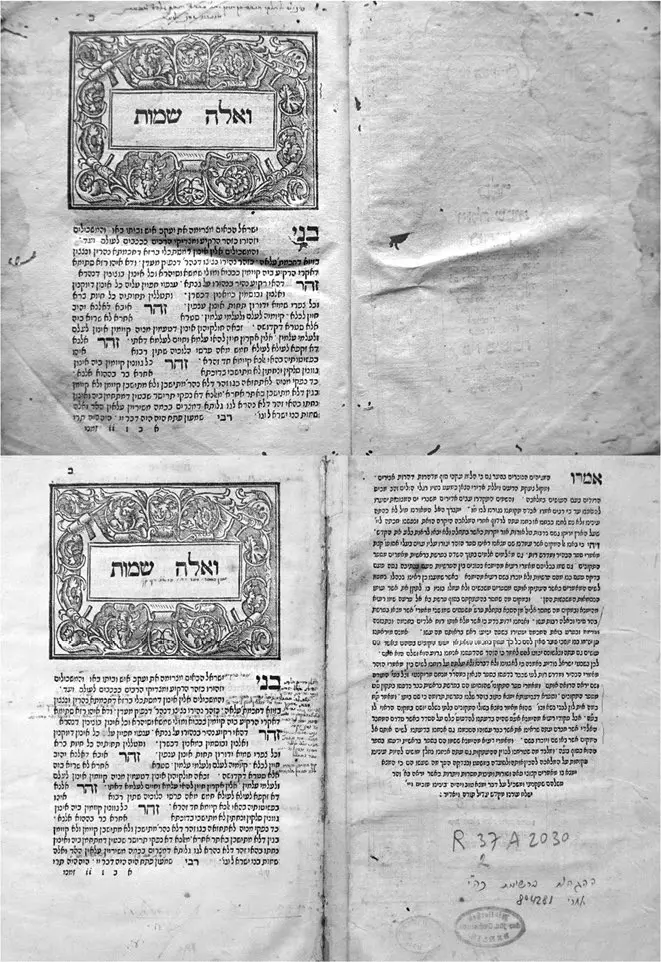
First, I have seen and heard of additional copies of the Zohar printed on vellum or blue paper8: Brad Sabin Hill,“Hebrew Printing on Blue and Other Colored Papers,”Treasures of the Valmadonna Trust Library, London and New York 2011, pp. 84–111. . 9 This is significant because it demonstrates a certain fluidity or the diversity of the product’s target audience. Printing on blue paper is more commonly associated with later printing houses in Eastern Europe, but printing on vellum has only been known since the first generations following the invention of printing and reflects the evolution of the status of the physical text, between manual reproduction in manuscripts and the printed book. In other words, a book was, in a sense, regarded as a manuscript. On this point specifically, the book’s subsequent life as a manuscript was incorporated into the intent and physical medium of the printed copy. One such example is the spectacular copy of the Mantua edition of the *Sefer ha-Zohar ‘al ha-Torah* in the library of the Schocken Institute in Jerusalem. This copy, printed on paper and incidentally bound in six volumes (with Genesis divided into two), features magnificent margins that were copiously filled with textual glosses and excerpts from existing commentaries by Zerachia ben Mordechai
The binding of the Schocken copy proudly displays the fourth title page for the Book of Numbers, even though it lacks a title page for the Book of Deuteronomy. This may suggest that the initial plan for the Mantua edition was to produce a five-volume edition, even though it was ultimately published in only three volumes. This suggestion aligns well with the changing plans and the interaction with the competing press in Cremona. 9 Yakov Meir shared with me his as-yet-unpublished theory—contrary to that of Benayahu and Abrams—that the replacement pages at the beginning of Bereshit, including the title page and additional pages at the end of the Book of Exodus in the Cremona edition, are best explained by a change in their plans to print a single-
-volume edition instead of a two-volume set. Applying a similar theory to the Mantua edition, we could also assume that they had planned a five-volume edition to compete with the Cremona printers, and having received a copy some time after the second volume was printed, they decided to bind all the remaining quires together into a third and final volume of the set. Of course, there are other explanations for the absence of the fifth title pages—such as the absence of the Zohar for the Devarim pericope—but they could still have printed a fifth title page; but no other explanation has addressed the issue of the omission of four title pages in the third volume). . The marginal commentary and detailed notes in this copy from the Schocken Library are just one of many reactions to the Mantua edition found on the printed page, indicating a degree of protest against that edition. But the production of such a copy with such foresight could also suggest that there was no presumption of finality in the establishment of the text of the printed edition, and we will see this as central to an assessment of the standardization of the Zoharic text.
Some copies also include text printed in Italian on the back of the title page, while in other copies, that page is blank 10See, for example, the Bodleian copy 4º I. 23 Th. Seld. . The Scholem and Schocken copies of the second volume of the Mantua Zohar have a blank reverse side of the title page, whereas all the other copies I have consulted contain a polemic by the printer11 See Ephraim Gottlieb, *Studies in Kabbalistic Literature*, Jerusalem 1976, p. 218, note 6 [Hebrew]. . It seems clear that the text was added rather than deleted, so Scholem’s copy is one of the few—or perhaps the only surviving—copies of the initial printing of this volume. We can therefore narrow down the time frame during which the Mantua printers received a complete volume of the Cremona edition to sometime after the second volume’s quires were printed but before it was bound.
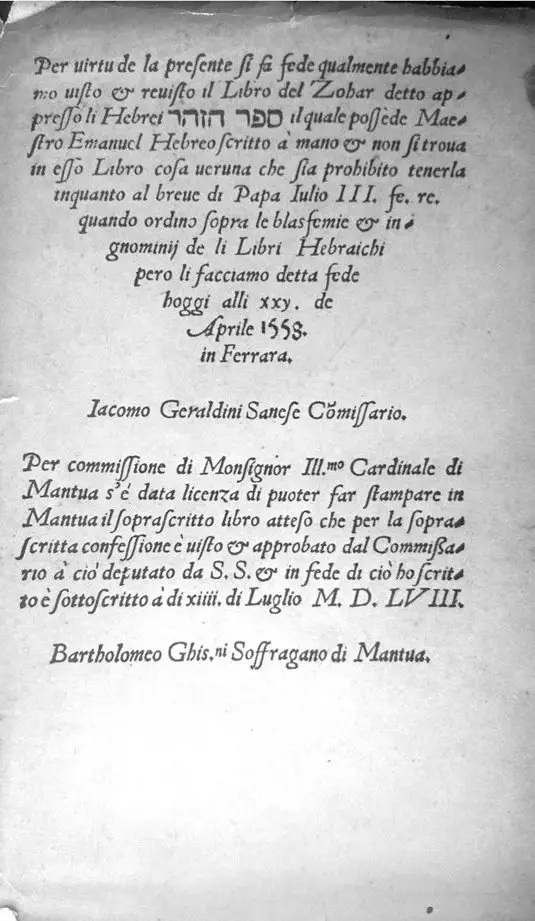
The aforementioned commentators also suggest that the sound of the clatter of the hooves of galloping knights could be heard. And from the sound of the shouts of the wicked and the wailing of the mighty flocks, the golden feet of the oppressors—drawn from the pockets of the people who labor—were nearly toppled. And the heavens darkened with mighty clouds; the turbulent waves of the stormy sea raged to scatter us, until many said, “Our hope is lost; we are doomed, God forbid.” Blessed be God, who has strengthened us; our eyes have not grown dim, nor has our vigor faded. As we were then, so are we now—able to pursue this precious work, and our souls wait for the Lord that He may pour out upon the earth showers of grace, dew of light, and precious rays, as in the beginning, and that they may not come to see the Holy One devoured. And when we came to the place where we had stood, we found and saw the eulogy of the Zohar; may the goats guard it. Among its contents were some passages from the Book of Light and the Midrash on Ruth. Also, scattered throughout the field in the portion of Genesis were passages from the Book of Corrections. They also included in their manuscripts passages from Ra’aya Mehemna, scattered among the parashot—sometimes in rough handwriting, sometimes in fine script; at times they compiled parashot from them, yet they did not mention the name “Ra’aya Mehemna.” When we heard this, we saw that they were alarmed and hurried to insert the passages as they had copied them from the distorting them, and its compilers did not labor to correct what those distorted versions had altered. And in the place where a mistake occurred in their transcription at the end of the parashah “Ba,” they attributed it to Ra’aya Mehemna, and in the place where something was missing from the grandfather at the beginning of the parashah “Mishpatim,” they inserted two passages they found in the parashah “Behar Sinai,” and they did many such things. And we know full well that he whom the Spirit of God has filled with wisdom, understanding, and knowledge—and especially with this wisdom—will shake his head in disbelief when he sees what they have done. However, out of fear that the gatekeepers—who have little interest in this wisdom—might speak ill of us, or that the sellers might entice buyers with their words, as they do even now, and deceive them with their tongues by saying that the Zohar we have printed is inferior and that theirs is complete. Therefore, we hereby declare before the tribes of Israel that we were not instructed, nor did we speak of it, nor did it ever cross our minds to insert passages from the Zohar, the Bahir, or the Midrash Ruth, since these have already been printed in the book of the Gaon, Rabbi Menachem Marikanti, z”l, in his commentary on the Torah, and there the reader may see them; and the passages from the Book of Tikunim that they added to the portion of Bereishit have already been printed in Tikun 69 of the number of Tikunim. And the “Sefer D’Tzniut” is found written in our Zohar in the portion of Terumah—namely, “For there is his home, and the teaching of the Torah scholars: ‘How great is the heart of the sons of Nasa,’ etc.”—which is a teaching found in the margins of the Tikunim, incomplete; it will be placed in its proper place, God willing. However, regarding “Pekudei Ra’aya Mehemna,” although it was our intention to print all in order, as arranged by the author, the Aldi, who compiled them—now that we have seen what has already been done, we too have agreed to place them in the section where they belong, and they will be remembered by name. And the essays of Ra’aya Mehemna, which are included in the Book of Genesis, will be printed in that book at the end, God willing.. And aside from the effort we have already expended in verifying the transcriptions, we are now also striving with all our senses to keep our eyes open to the task of preparing it for service in justice and righteousness—unlike what they have done—for one may find in it truncated passages, missing lines, and missing words and superfluous ones. As will be seen in the *Zohar* of their own, which I have corrected, and whoever is knowledgeable about the matter will find it good, and may the Lord be our witness among us; may He send us help from the Holy Temple, magnify the Torah, and glorify it.”
Presented here for the first time in a scholarly study is the text found in certain copies of *Zohar ‘al ha-Torah*, Mantua 1559, volume 2, fol. 1b. Note the criticism of the placement and identification of the texts in the Cremona edition compared to those in the Mantua edition. The printers also noted that the editors in Cremona had omitted texts from Recanati’s Commentary on the Torah, printed in Venice in 1523, noting that it was unnecessary to reproduce texts that had already been printed. Furthermore, the printers criticized the inclusion of texts from the Tiqqunim that had already appeared in their own edition in 1557.
The most significant known variation among the printed copies of the Mantua Zohar, *Zohar ‘al ha-Torah*, is found in a different copy from the Es Hayyim Library in Amsterdam, on loan to the National Library of Israel. In an ironic twist of fate, this copy serves as the virtual copy of the Mantua Zohar collection on the Jerusalem website. In any case, this copy can be viewed online via a scan of the microfilm made years ago. This copy contains a different text for at least the first few folios of the Zoharic text in the first volume. I published an article on the so-called “Introduction to the Zohar,” Haqdamat ha-Zohar, 25 years ago to show that it predates the other12known copies. Daniel Abrams,“When Was the ‘Introduction’ to the Zohar Written, and Changes within Differing Copies of the Mantua Printing,”Asufot 8 (1994), pp.
211–226 [Hebrew]. My conclusion was that they literally stopped the presses in Mantua when they saw the Cremona edition—or part of it—and reset the plates to produce a text that had been revised in light of what they had seen. A second copy of this unique version is held in the Christ Church collection at Oxford (MA.7.11).
Further work is needed to determine the extent of the changes—that is, to what extent the text has been altered. It should be noted that the introductory material refers to page numbers in the volume, and thus these pages were printed at a later date; consequently, the investigation must focus on the so-called introduction to the Zohar and Parashat Bereshit. Finally, I would like to mention the pirated edition of the Mantua Zohar, which is said to have been printed in Venice as a forgery of the Mantua edition.13 See Zeev Gries, *Conduct Literature (Regimen Vitae): Its History and Place in the Life of Beshtian Hasidism*, Jerusalem 1990, pp. 73–75; see also Gila Pribor,“Domenico Yerushalmi’s Sefer ha-Ziqquq,” *Italia* 18 (2008), pp. 139–140 [Hebrew] . 14 These copies were intended to be identical reproductions of the Mantua edition sold to Ashkenazi communities outside the regions where Mantua printers sold their wares. Perhaps these printers thought they would not be caught, and indeed the existence of this edition only became known because of repeated citations of an inferior text, corrupted transcriptions of the Mantua edition in the composition of the pirated version, which have been consistently found in citations from various works referring to the Mantua edition. I hope that a copy of this unauthorized edition will be discovered soon—perhaps sitting on a shelf in a major library right now, miscataloged as the Mantua Zohar.
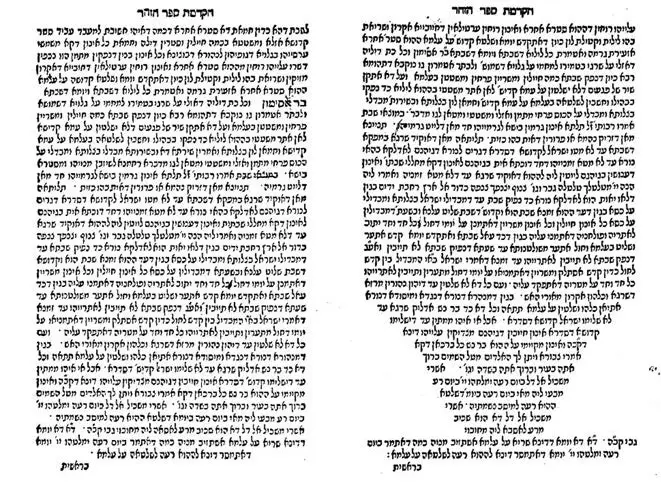
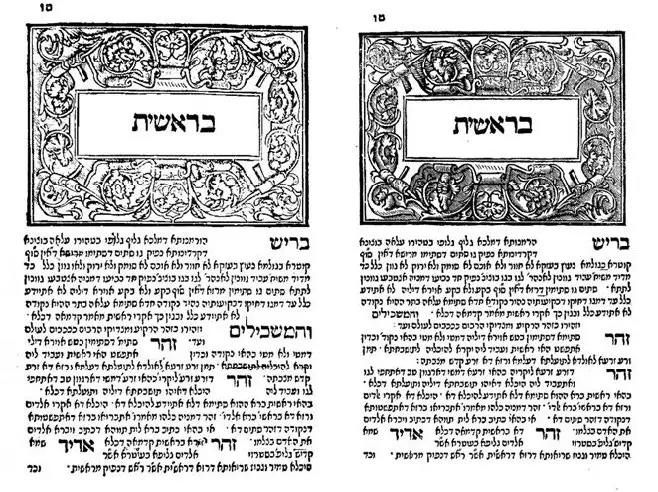
; on the right, the Es Hayyim copy
Self-Awareness and Editorial Practice in Mantua
The printing of the *Sefer ha-Zohar ‘al ha-Torah* did not mark the beginning of the printing revolution—neither in Jewish printing nor in Kabbalistic literature. It has become a commonplace—and indeed a dogma—among historians and scholars of Jewish literature to claim that the Zohar replaced the Talmud, the printing of which was prohibited by the Church at the time. Undoubtedly, this view aligns with traditional accounts according to which the Zohar was composed by the Tanna, R. Shimon bar Yohai. And although this explanation suits those who construct historical narratives, it is only part of the story. Many Kabbalistic books were printed during this period in Mantua and at other printing houses, and not all of them were pseudepigraphical. Another major problem that historians must address is the proliferation of publishing efforts during those same years in Italy. I am referring, for example, to the printing of *Ma’arekhet ha-’Elohut* in Mantua and Ferrara in 1558.15 The two editions are nearly identical, including the commentaries surrounding the text. This raises the question of why the Mantua printers were engaged in two projects to produce Kabbalistic books at the same time as others, all seeking to produce the same volumes. Furthermore, the results are so similar that one must wonder whether they had access to the same manuscripts or, possibly, whether one of the publishers was working for both printing houses. My argument, therefore, is to reverse the methodology of a comparative study and ask not how the two editions differ from one another, but why they are so similar.
In any case, there is still much work to be done. The Zohar has been a subject of academic research for a hundred years now, ever since the work of Adolph Jellinek and Gershom Scholem in the early 20th century. It might be preferable to frame the question more broadly as a critical inquiry that examines the quality of the text, raises historical questions based in part on a comparison of sources, and challenges the ideological hypothesis. I refer to the critical works of Jacob Emden 14and Oded Yisraeli,“The Controversy on the Antiquity of the Zohar in Its
Sabbatean Context: The Purposes of ‘Mitpachat Seforim’by R. Jacob Emden,” El Prezente 10 (2016), pp. 61–71 [Hebrew]. and Elyaqim Milzahagi 15Daniel Abrams,“Nineteenth-Century Precedents of Textual Scholarship on Kabbalistic Literature: Elyaqim Milzahagi’s *Zoharei Raviah* (Ms. Jerusalem,
NLI 4° 121),” *Kabbalah* 31 (2014), pp. 7–25. whose ideological commitments enabled them to identify the issues and conclusions reached by others with different, strongly held ideologies that shaped certain views on the Zohar and its text. And even if we were to add many other great minds to this list, no serious research has yet been conducted on the Mantua edition of the Sefer ha-Zohar ‘al ha-Torah, Mantua 1558–1560. Admittedly, one-page descriptions have been offered as part of the history of the printing, or references to the printer have been cited in the context of a discussion on the debate surrounding the publication of esoteric works of Kabbalah. No further research has been conducted since then, with the notable exception of Boaz Huss’s study on the reception of the Zohar and his detailed examination of the Sulzbach edition. 16Boaz Huss,“The Text and Context of the 1684 Sulzbach Edition of the Zohar,”Tradition, Heterodoxy, and Religious Culture; Judaism and Christianity in the Early Modern Period, ed. C. Goodblatt, H. Kreisel, Beer-Sheva 2006, pp. 117–138. .
Here, I would like to offer an analysis of the statements and the actual implementation of the Zohar printing project in Mantua. There is an inevitable gap between rhetoric and reality. Most scholars have relied on the Mantua edition as being superior to the Cremona edition, whereas in general the opposite is true. Scholars such as Isaiah Tishby have pointed out the number of manuscripts used in Mantua—ten—compared to six in Cremona. Whatever the differences between the two editions, the number of common features is surprising. There would be many benefits to explaining why there were so many shared editorial decisions between the two editions. Was there shared access to various manuscripts, or did someone advise both printing houses? We know little about what they possessed and how they used their texts. Nevertheless, Tishby’s summary—which is perhaps the only in-depth discussion—is worth noting:
Rabbi Emmanuel of Benevento was the one who established the text for the Mantua edition, and according to one of the printers, Rabbi Jacob Hacohen of Gazolo, cited at the end of the Tikkunei ha-Zohar, he used ten manuscripts. First, he chose two whose texts seemed to him to be the most reliable, as the editor states in his preface to the Zohar: “to correct and establish the text of his version using two copies that experts could consider to be good and reliable.” Subsequently, he acquired a manuscript from Safed and used it as the basis for compiling the final text. It would appear that Rabbi Emmanuel, in comparing the various manuscripts, carried out serious and responsible philological work. In general, he included only the text he ultimately selected, but in a few places, he notes alternative readings. The Cremona edition was based on six manuscripts, as stated in the preface, “two of which we used as our main guides (lit., were like eyes to us),” one from Egypt and one from Palestine. Doubtful readings were examined by experts, and if they approved the text common to most manuscripts, then only that single version was printed. But if they preferred a minority reading, this was also cited in “small Spanish type.” There are significant and obvious differences between the two editions, both in the text and in the order of the various passages. There are also several passages that appear in one edition but are missing from the other. A detailed scholarly comparison has yet to be conducted, but in general, one can say that the Mantua text is the better of the two.
Isaiah Tishby, *The Wisdom of the Zohar*, trans. D. Goldstein, Oxford 1989, p. 98.
The number of manuscripts, that is, citing a specific number, is of little importance, since we know that most manuscripts contain only certain texts or sections of the Zohar, and many may still be partial witnesses to the entire work—not to mention their unknown textual quality. Tishby’s interpretation further suggests that they identified the appropriate text based on a “democratic” review of the statistics, favoring the reading that appeared in the majority of cases. This is undoubtedly poor philology, and I am sure that Tishby and the Mantua editors are aware of this.
Before moving on to an analysis of their methods, I will cite Moses Zacuto, who praises and prefers the Mantua edition over the Cremona edition in his *Iggerot ha-Remez*. His comments are relevant here, if only as an early indication of the unfounded preference for the Mantua edition, which continues for similar reasons to this day.
First and foremost, it should not be standard practice to follow the Zohar (of Cremona); rather, one should use the smaller edition, printed in Mantua. First, because the large edition is available to very few people, and also because it is full of errors and one cannot benefit from the marginal glosses of the Rabbi, may his memory be blessed [Isaac Luria], which I printed in Sefer Derekh Emet, since the layout of the text does not correspond to [those pages]. Consequently, since the large Zohar is riddled with errors, you will not be able to correct them according to the Rabbi’s glosses.
Moses Zacuto, *Iggrot ha-Remez*, Livono 1780, fol. 2a.
Here we see Italian Kabbalists absorbing the Safed tradition, given the complete absence of these resources in the efforts of Italian printers nearly a century earlier. Zacuto emphasized the importance of the Mantua edition because of its dominance in Italy and because he wished to promote the supplementary works he had printed in Italy. He therefore retroactively incorporated sources from Safed into one of the two editions printed in Italy and consequently sought to discredit the Cremona edition, which served the Ashkenazi communities. Let’s just say that Zacuto was wrong. The Cremona edition has many better readings and is less refined than the Mantua edition, which appears to have been intentionally prepared more as a commercial venture and thus sought textual uniformity. We are now ready to focus on the printer’s presentation of the Mantua edition, which was printed and bound in the last volume.
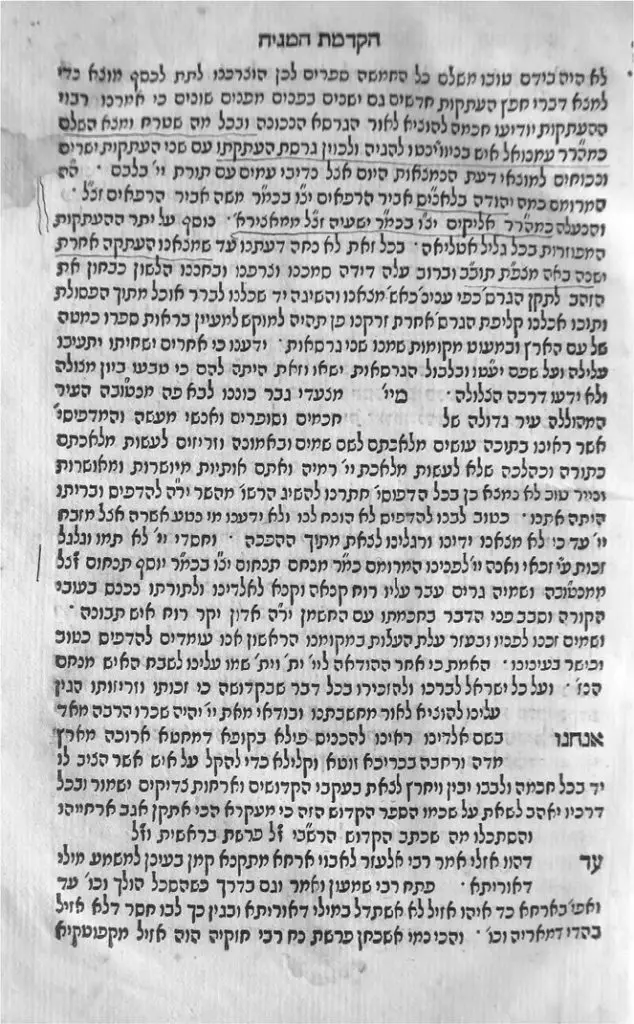
They were unable to complete a copy of the five books. Consequently, we were forced to allocate funds to acquire what we wanted—both new and old copies—which had been hidden in various locations. For we have said that multiple copies would bring wisdom by enabling us to publish the correct version (le-hotsi la-or ha-girsa Ha-nekhona) And through all the efforts of our exemplary teacher, Rabbi Emanuel Benevento, to proofread his text and bring it into alignment with the manuscript witnesses considered by experts to be accurate and faithful (le-kavven girsat ha-ataqato ‘im shnei ha-‘ataqot yesharim u-nekhonim lemotsei da’at)—which we find today among the leaders of the people, those who have the Torah of the Lord in their hearts: [The copies are found with] our honorable teacher, the leader (ha-adonim ha-nikhbadim, ha-nasi ה׳׳ה הנשא), our master Rabbi Judah Blanes, the master physician, may God protect him and grant him a long life, son of our teacher, Rabbi Moses, the master physician, may his memory be blessed and his honor exalted, our teacher Rabbi Elyaqim, may the Lord protect him and grant him a long life, son of the honorable, our master, our rabbi, Isaiah, may his memory be blessed, of Macerata, in addition to all the other copies scattered throughout northern Italy. Even so, we were not satisfied until we found another ancient copy that came from Safed, may it be built and rebuilt. And when it came into our hands, we relied on it and added it [to our collection of sources], and we scrutinized its text as one purifies gold, in order to establish the text according to the needs of the collection based on the questions raised by it. And to the best of our understanding, we sought to separate the edible food from the waste, and from that, we ate. The other readings, which were like the peel [enveloping the edible fruit], we discarded, lest they become an obstacle for the discerning reader who would see his book [as suitable to serve] as a guide for the lay reader. And in a few places, we have included two [different] readings. We knew that there would be others who would undermine [our efforts] and conspire with hatred, and they would have to cover their upper lip [Leviticus 13:45], and the confusion of the textual readings they would put forward would be for them as if they were “plunging into deep mire” (Ps. 69:3) and did not know how to extricate themselves 17 See the comments on this passage by Tishby,“Polemics about the Printing of the Book of the Zohar in the Sixteenth Century,” Peraqim 1 (1968) 143, reprinted in: Studies in Kabbalah and Its Branches, Jerusalem 1982, p. 91 [Hebrew]. In the printer’s notes on the verso of the title page of the second volume, it states: “We took pains to align the copies,” .
This is a very dense passage that describes their self-awareness as publishers, and its meaning must be situated somewhere between what they had planned or actually accomplished and the rhetorical presentation of what they wished to convey in order to convince their readership of what they had achieved. The passage begins with their stated acknowledgment that they knew nothing of the complete text of the Zohar and that they needed to compile various sources from northern Italy to construct a complete text for their project. The belated acquisition of a manuscript from Safed should probably be taken at face value, even though Safed’s authority is significant for the credibility of their edition. And so, it appears that they created a new copy of the text from various Italian sources and subsequently found it necessary to modify it significantly so that it would correspond to this ancient Safed manuscript. Here, I would like to note that studies of Kabbalah have recognized what the printers inadvertently expressed in their comments: that the study of the Zohar should not be conducted from a “work”-centered perspective in which manuscripts serve merely as sources of information. It is better to situate the manuscripts geographically along the historical lines of their transmission and reception as markers of their compilation and evolution, in order to better appreciate the changes in the way the Zohar took shape and was reshaped. 18This forms the basis of Amiel Vick’s doctoral research on the Tiqqune Zohar manuscripts. Another example of this shift in Zohar studies is Avishai Bar-Asher,“The Earliest Sefer ha-Zohar in Jerusalem: Early Manuscripts of Zoharic Texts and an Unknown Fragment from Midrasha-Neʿelam [?],” Tarbiz 84 (2016), pp. 575–614 [Hebrew]. .
There is a significant tension in their theory of editorial practice that is new to the 16th century. The passage cited refers to the establishment of the correct version, ha-girsa ha-nekhona—not merely a better text or one free of errors, but apparently the singular version that ought to be, or that existed before it became corrupted through the vicissitudes of the historical transmission of the Zohar. This tension stems from their self-awareness of being engaged in both recovery and invention. It is clear that they understood the sources to be approximate and dependent on access to manuscripts of varying scope and quality, as well as on their own ability to sift through them and reject erroneous readings. And yet, they were also aware that even though they wished to be definitive in their textual determinations and to present a clear text, they nevertheless felt compelled at certain points to offer supplementary information, such as passages placed in parentheses, as an alternative possibility.
The unanswered questions regarding the Mantua edition are: What was its purpose? What sources did they use, and how did they use them? Is the Mantua edition of the Sefer ha-Zohar ‘al ha-Torah was prepared from a manuscript that was subsequently lost and then sent to press, or did they proceed volume by volume, typesetting directly from the manuscripts in the printing house? Were there two teams working on the Tiqqune Zohar and the Zohar simultaneously, or one after the other? Why was the book of the Tiqqune Zohar prepared first, and why, as Amiel Vick has pointed out, are its text and layout not found in any of the manuscripts we have today? As Tishby notes in his article on the controversy surrounding the printing of the Zohar, Abraham ben Meshulam continued the editing of the third volume of the Sefer ha-Zohar ‘al ha-Torah on his own. Apparently, Emanuel Benevento died after the first two volumes had been written and published. Consequently, it would be important to compare the editorial practices and differences between these volumes, not to mention a comparison between the Tiqqune Zoharand the Sefer ha-Zohar ‘al ha-Torah.
In examining their methods and statements, I distinguish between (a) their self-awareness as expressed in print—which may be merely rhetorical and consist of statements directed at the reading audience— and (b) my assessment of what their self-awareness was based on—namely, editorial and textual decisions applied in the printed edition. The editor or proofreader (magiah) inserted a few notes throughout the text, aside from the occasional alternative readings in square brackets. I will now turn to these comments, which reveal a certain degree of intervention; their critical observations express a desire for readers to see them. Perhaps their unspoken editorial decisions are more significant for an assessment of their project, particularly in relation to the manuscripts of the Cremona printing. Cataloging and analyzing these notes is a fundamental first step toward the massive undertaking of understanding the Mantua edition.
Perhaps the most important statement is the editor’s note at the end of the Mantua edition of the Tiqqune Zohar:
The proofreader says: This is all I found, and perhaps these eleven tiqqunim are part of the seventy, but no one was able to mark them [correctly]. I have already [kevar, or “now”] found more collected passages [of the tiqqunim]. And [since] my heart tells me that they are not part of the tiqqunim—they are just scattered passages from the Sefer ha-Zohar—I have set them aside to keep them safe until I know what will become of them. And if God stands by my side and guides me in the path of truth, I will complete [my efforts here] and print them with precious and impressive words that have not been seen or revealed until this day. And blessed be the Lord, who has not turned away my prayer or His grace from me, and has granted me this privilege.
Here we have evidence of an uncertain understanding of the literary boundaries of the work and its relationship—its intertextual relationship—with what it is understood to be the Book of the Zohar, which is to be printed in Mantua shortly. The addition of eleven tiqqunim and the embarrassment or confusion caused by the fact that there were not exactly seventy tiqqunim was compounded by the discovery of even more manuscript material of this style. To be sure, the editor realized both that the additional collectanea were by the same person—written by the same author or at least in the same style as the tiqqunim—but he also demonstrated sufficient literary discernment to realize that they were not part of the same program or the same literary work.
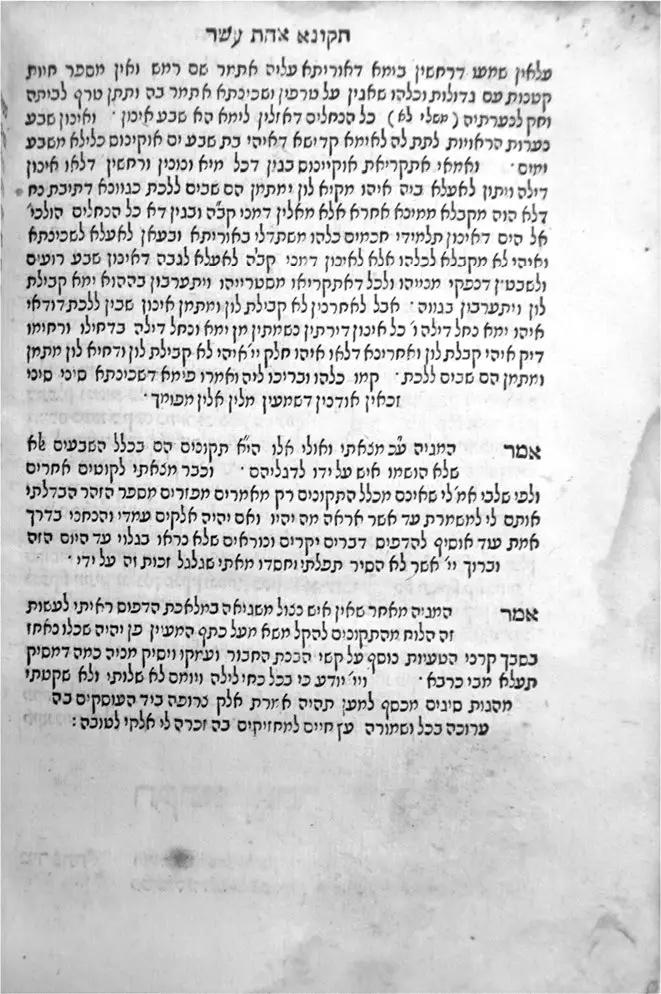
In the Zohar’s pericope on Bereshit from the Torah, a large section of text from the Tiqqunim was printed as an integral part of the Zohar, but these are apparently not the texts discussed here, and there are precedents in manuscripts for this textual placement, such as the Toronto manuscript. It seems more likely that he was referring to what would later become known as the Tiqqunim
he-Hadashim, since they were later printed in a volume known as the Zohar Hadash. Amiel Vick’s research on the manuscripts of the Tiqqune Zohar will be the first major step in examining the manuscript evidence from the late 13th century until its printing.
The printers of Mantua largely produced a polished work with the textual consistency and organizational structure of a standard commentary on the Torah. As artificial as it may be, it achieved its objectives. Nevertheless, there are a number of instances where the printing broke the unspoken presentation of an edited work and revealed its unease with its own editorial decisions, thereby showing the reader their struggle. These comments are:
The commentators said: “From the foreign language, it is evident that this is not from the Zohar, and the light is evident from the darkness.” (And in our opinion, the letter “Vav” is from the Hidden Midrash and was in the Holy Tongue, and those who sought to boast by claiming it was “the language of truth” lost the intent and understanding of the passage, for they neither knew nor understood how to render the language according to its original form. And behold, it will appear to every reader as the words of the sealed book, and we had already omitted it, since in the copy that came from Safed, may its memory be a blessing, we did not find it. However, so that those who see it will not boast against us, saying that our work is incomplete, we have printed it as it is, and we have no power to correct what they have distorted.
Beginning of Wa – Yehi 1 211b19
See Huss, *The Zohar: Reception and Impact*, p. 103.
Zohar 2:52a describes the arrangement of the letters in a diagram that is not printed. Later editions will include the diagram showing the arrangement of the letters on pages 269b–270a.
The proofreaders said, from the beginning of the parashah until “Ma’aseh Yadei” (
Zohar 2, 94a (Mishpatim)
). To clarify: K”Y”D A’ is from the Saba, and we have examined it and found the text to be accurate, T”L.
The editors say: “We have found and seen that these verses are few in the copies in our possession today; therefore, may those who study the text not hold this against us. And when accurate copies become available, the errors will be corrected, and what is crooked will be made straight.”
Zohar 2:148a
The editors said: “This is what we found in all the copies before us, and from the wording it appears that something is missing here.”
Zohar 2:121a
Subsequent editions published in Constantinople (1735) and later will include this passage as an appendix to the Zohar Hadash 68a
The proofreader said, “I found this passage written here. Since it has already been printed in the portion of Vayikra, folio 6, column 2, line 21, and concludes on folio 8, column 1, line 26, I did not want to print it a second time.”
Zohar 3:86a
Zohar 3 :127b: “The spring is a path to remove obstacles,” said the commentator Abraham, which contains a fairly lengthy commentary on anthropomorphism.
Zohar 3:150b and subsequent editions add to this note that it was printed at the end of the second volume, notably in the Constantinople edition and subsequent editions.
Printed in *Hakmat Bereshit*, folio 10b
Zohar 3, 269b
This is a remarkable comment, since the passage at the end of Parshat Pinhas—which was originally composed as part of this pericope—has been moved to the introduction in the manuscripts. What this tells us about Mantua is that they printed as they went along and that they possessed neither an older manuscript of the Zohar on the Torah nor an edited document that they had prepared in advance from which they were working 20 See, however, Zohar 1:214b, as stated in the parashah Acharei Mot. On the above and the Introduction to the Zohar, see Yakov Z. Mayer,“The Introduction to the Zohar: Text, Structure, and Editing,”Kabbalah 33 (2015), pp. 153–182 [Hebrew]. The study of duplicate passages in the Cremona edition has already been addressed by Asher Zelig ben Moshe in his *Hibbur Amudei Sheva*, Krakow 1635. A similar examination should be undertaken for the Mantua edition of *Sefer ha-Zohar al ha-Torah* to identify similar or repeated passages as indicators of the history of the Zohar’s editing from various manuscripts. See, for example, Zohar II: 64A II: 207a and Matt’s commentary, *The Zohar*, Stanford 2007, vol. 4, p. 346, n. 20. The editors of the Tiqqune Zohar in Mantua were aware that such duplication would be inevitable due to the overlap in the various manuscripts they consulted while compiling their edition. See the note in Tiqqune Zohar, fol. 107a: “The proofreader said: ‘I found this correction scattered, disjointed, and misleading, and I spent much time and effort correcting it and arranging the material twice, due to the transposition of the letters.’”
There are very few comments and notes on alternative readings in parentheses in the first volume, but this increases in the second volume and even more so in the third volume. For example:
Zohar 1:77a (Metatran)
1, 112a Midrash ha-Neelam (N’A, full text)
1, 121a (N.A. Tishrei 14a in the text)
I note that additional comments are blocked in the text boxes at 1:60b and 1:62. Volume Two contains numerous variant readings in square brackets, and curiously, the wording shifts from *nosah aher* to *sefer aher* (e.g., 2:3b; 2:4a; 2:5a), which could indicate a change in editors or editorial policy, or it could be technical terminology referring to specific manuscripts or a particular interpretation of the text. Consequently, my assessment is that there was a progression and a shift in editorial practices as the three volumes were produced. The compilation therefore appears to have been carried out volume by volume, and I do not get the impression that the typesetters consulted a final, already-edited manuscript version among the ten manuscripts mentioned that were available to them.
Apparently due to competition with the Cremona editions, the publishers sought to improve their edition and, at a late stage of preparation, began gathering additional text and inserting it into what they knew to be a limited understanding of what the Zohar is. This is particularly interesting because they deliberately broadened the scope of what would be included in“Sefer ha-Zohar al ha-Torah,” demonstrating a liberal interpretation or flexibility regarding what is or could be defined as the Book of the Zohar. Of course, one could argue, as I do, that they also knew they were not printing the Book of the Zohar as it was originally composed, but were instead creating a commercial and cultural product for public consumption in their own time, and thus these questions were not even under consideration. Thus, the Mantua printers began to include the Midrash ha-Ne’elam in columns running parallel to what was titled “Zohar.” They included some but not all of the passages from the Midrash ha-Ne’elam, demonstrating, I believe, that they sought to improve the edition but not to publish the entire Zoharic corpus. The number of passages from the Midrash ha-Ne’elam would decrease in the second volume and be almost entirely absent in the third volume, but not solely because the literary output of the Midrash ha-Ne’elam focused on the earlier pericopes of the Pentateuch. Rather, it may be that once they saw how few of these texts were included in the Cremona edition—either at the time of the printing of the first volume of the Mantua edition in 1558 or, more likely, upon the completion of the second volume— they realized they could abandon this intensive effort to include the Midrash ha-Ne’elam. I therefore believe that the editors of the Mantua edition possessed more complete manuscripts of the Midrash ha-Ne’elam on the Torah and refrained from publishing everything they had. The significance of this conclusion is profound, as it has implications for what and why certain texts were included and edited in the volume published in Thessaloniki in 1597. Passages from the Tosefta also appear to have been added in a similar context. Note that the short passage titled “Tosefta” in Zohar 1:31b is in fact a paraphrase of the opening section ofthe “Commentary on the Account of Creation” attributed to Asher ben David. Does this indicate a sense of hopelessness regarding the improvement of their work, or is it a reflection of a misunderstanding of the manuscript evidence available to them?
On the other hand, an examination of the Cremona edition shows that they did not have any manuscripts of the Midrash ha-Ne’elam and resorted to reproducing excerpts from the 1523 Venice edition of Recanati’s Commentary on the Torah (as indicated in the remarks of the polemical printer in the Zohar, Mantua 1559, volume 2, fol. 1b)21Gershom Scholem,“Havdalah de-Rabbi ‘Aqiva: A Source from the Jewish Magical Tradition in the Geonic Period,”Tarbiz 50 (1981), pp. 244–245 [Hebrew] = Scholem, Devils, Demons and Souls: Essays on Demonology, ed. E. Liebes, Jerusalem 2004, p. 147 [Hebrew] . We shouldn’t be wondering about the differences between the Mantua and Cremona editions, but rather why there are so many similarities. One might speculate about a publishing spy—someone who worked for both projects (as a double agent)—rather than assume that rumors spread from one of the two printing houses about what the other was doing. We know that Vittorio Eliani saw the Zoharic texts prepared in Mantua and later worked on the preparation of the Cremona edition, as evidenced by a note on the last page of Scholem’s copy of the Mantua 1557 Tiqqune Zohar: “Revised by me, Vittorio Eliano, who requires no correction.” 22 These two passages were presented and discussed by Saverio Campanini, ‘On Abraham’s Neck: The First Edition of the Sefer Yesirah (Mantua, 1562) and Its Context ’, Rabbi Judah Moscato and the Jewish Intellectual World of Mantua in the 16th–17th Centuries, ed. G. Veltri, G. Miletto, Boston-Leiden 2012, p. 255. Tishby, in“Polemics,” pp. 146–147, expresses doubt that Eliano collaborated with Gatigno. I would like Amiel Vick to examine this question.

Scholem noted on the title page of this same copy that Eliano was the grandson of Elijah Bahur, and that his connection to the printing house was sufficient to exempt the printer from any (further) censorship.
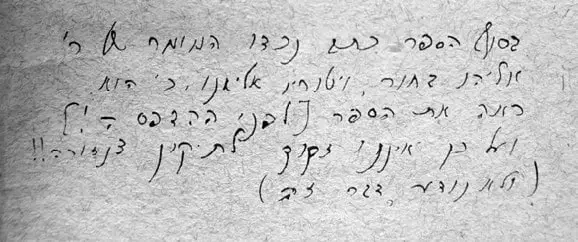
, verso of the title page, Scholem Library R2141
At the end of the book, Rabbi Eliyahu Bachur’s converted grandson, Vittorio Eliano, wrote that he had seen the book (before it went to press!) and therefore it did not require any censorship corrections!! (And this fact is not known)
Further information on this subject is provided in the notes by Emmanuel of Benevento in his edition of the Leviat Hen, Mantua 1557, fol. 3a in what appears to be a letter to his son, who, along with others—אני ורעי—prepared an edition of a beloved book that had been burned, perhaps the Zohar al ha-Torah.
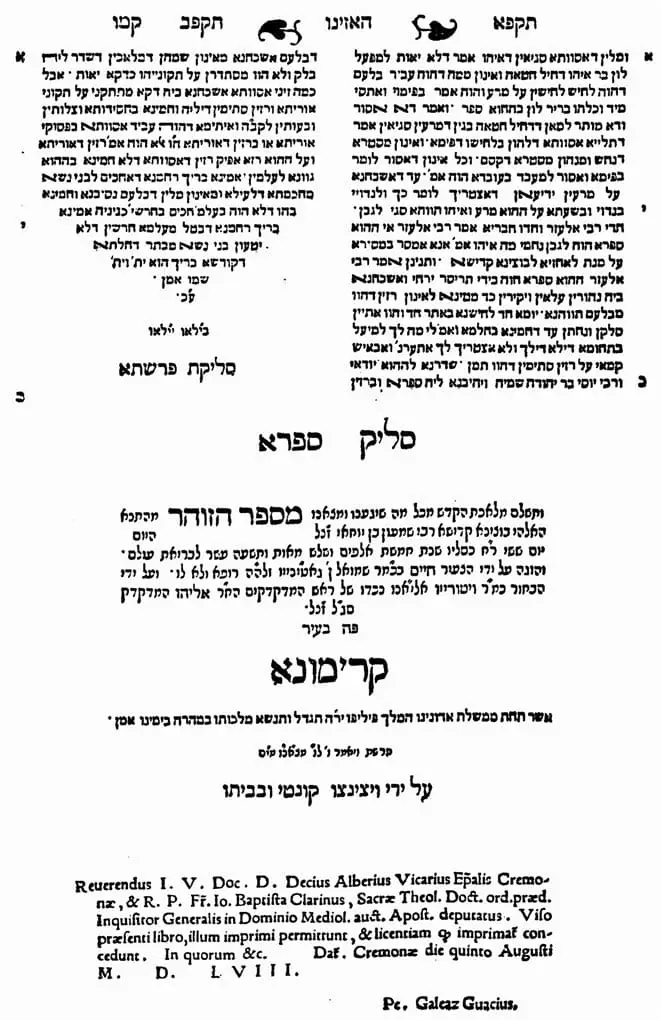
Note that the volume was completed in Kislev 5319 (December 1558) with proofreading
by Hayyim Shmuel Gatigno and Vitorio Eliano, the grandson of Elijah Bahur
The Zohar of Mantua and a Critical Text of the Zohar
The Mantua Zohar is not a critical edition, even though it sought to compile and standardize a single text based on multiple manuscript sources. The edition did not reveal its sources, nor did it, in principle, intend to challenge the reader with philological problems. The stated goal and the final result were a standard text that could be used by many and would spare its readership the need to compare manuscript sources. To assess how they operated, extensive research would be required to identify what was in their possession; however, this would, of course, be impossible to prove, since their text is a hybrid of numerous sources, some of which may not have survived, and similar tests could yield false positives in such an investigation. As for the success of their efforts, it is necessary to examine the reading practices of those who used these copies, as well as the manuscript and printed works that shaped the printed text. Here, the evidence is quite clear that a more critical analysis of textual comparisons was carried out after its publication.
A major breakthrough in the study of the first printed edition would be to identify the manuscripts used by the printers in Mantua. This project cannot be separated from the study of the manuscripts used by the Cremona printing house, and it is possible that there was some overlap between these manuscripts. In the first volume of his translation of the Zohar, Daniel Matt suggested that the following manuscripts are similar and may have served as the basis for the Mantua edition
: Ms. London, BL, Margoliouth Catalogue no. 762 (= Add 17745); Paris, Bibliothèque nationale de France, heb. 781; Parma, Perreau 15 / A (= 2718) 23 The Zohar: The Pritzker Edition, translated and annotated by Daniel C. Matt, Volume 1, Stanford 2014, p. xvi, note 4. . These and others must be carefully sorted through, but as we have seen, the printers did not follow any of them; instead, they combined them to produce their own clear text. The question, therefore, is not simply whether to confirm or reject these candidates as part of the pool of sources available at the Mantua printing house, but rather how they were used. In fact, the focus is on what was rejected and what principles guided their editorial decisions regarding any similarities between these manuscripts and the printed text.
As part of this investigation, we should ask ourselves what conditions were compelling enough for these editors to abandon their stated goal of producing a single version and instead include alternative readings in parentheses. My preliminary examination confirms that these manuscripts are similar to the printed edition and similar to one another, which may not demonstrate the stability of the text within this family of manuscripts any more than it says anything about the Mantua edition. In other words, it may demonstrate that, within this collection of manuscripts, all are representatives of a branch or family that was available to them in Northern Italy, as stated in the printer’s introduction.
Italy and Safed: Competition and Influence
The printers in Mantua were cut off from the Kabbalists and manuscripts of Safed, and their editions suffered as a result. We learn this from the handwritten notes and critical commentaries of the Safed Kabbalists, and above all from the reactions of Moses Cordovero, Isaac Luria, and Hayyim Vital. Indeed, they accepted the printed edition as the standard, but rejected the text as a standardized or final product. Cordovero, as we know, was already—perhaps simultaneously, or just prior—engaged in establishing a literary framework for all Zoharic texts, the Tiqqune Zohar, and the Zohar on the Torah, based on multiple manuscripts. I began collecting all the passages where Cordovero referred to different or alternative readings or where he mentioned his efforts to verify the manuscripts (sefarim). Elijah de Vidas, a student of Vital, uses the printed editions, but on a number of occasions he quotes various Zoharic texts from ketivat yad, some of which correspond to texts from the Tiqqunim published later in the Zohar Hadash 24 I have identified eleven references to handwritten quotations from Zoharic textsin *Reshit Hokhmah*, *Sha’ar ha-‘Ahavah* ( Volume 1), ed. Hayyim Waldman, Jerusalem 1984, *Sha’ar ha-Yirah*, ch. 1, section 37, p. 46 (Venice, fol. 5b); ch. 1, section 24, p. 359 (Venice, fol. 73a); ch. 5, sec. 10, p. 435 (Venice, fol. 91b, misprinted as 95 [b]), and four in *Sha’ar ha-Qedushah* (Volume 2): ch. 2, sec. 11, p. 23 (Venice, fol. 192b); ch. 7, sec. 86, p. 186 (Venice, fol. 231a); ch. 7, sec. 7, p. 137 (Venice, fol. 220a); ch. 7, sec. 85, p. 182 (Venice, fol. 231a); ch. 7, sec. 107, p. 195 (Venice, fol. 234b); ch. 7, sec. 119, p. 202 (Venice, fol. 236b); ch. 11, section 35, p. 274 (Venice, fol. 254a). In ch. 17, section 10, p. 505 (Venice, fol. 308b), Vidas quotes a passage from Parashat Noah, apparently from the printed edition, and then notes another manuscript reading: “and in some versions of the books it is written: ‘in the camp of Tiubata, Takifa’” . There appears to be a consolidated list of what is missing from the volumes, nor is there any manuscript that could be used for the three-part collection to be published in Thessaloniki. His methods are similar to those of Cordovero in that he cites other textual versions, but he does not appear to have had access to his teacher’s magnum opus. The conclusion, therefore, is that De Vidas uses the Mantua edition and certain manuscripts for additional texts or readings. He did not have a consolidated manuscript notebook of the texts that would be printed in Salonika. His work in *Reshit Hokhmah* should be placed at the very beginning of the Safedite reactions to the printed *Zohar* and to the completion and distribution of the notes and manuscript notebooks of Luria and Vital. Here we have yet another chapter in the history of reactions to the Mantua printing, and with greater precision, we can break down Safedite textual criticism into its various stages 25 For interpretive commentaries on the Zohar attributed to Vital that do not include textual criticism, see Ms. London Beth Ha-Din 113, folios 175a–211a, which concludes with the following attribution: “A commentary on the Zohar from the entire Torah, and it is what was transcribed from what is written on the folio and within the Book of the Zohar by Rabbi Chaim Vital, of blessed memory.” .
When Luria and Vital received copies of the Mantua editions, they wrote countless comments and additions in the margins of their copies. An autograph copy of these notes on a Mantua Zohar on the Torah, in the handwriting of Hayyim Vital and Shmuel Vital, was seen by Joseph Avivi in a private collection, and I have seen others in later copies. Numerous other handwritten notes exist in the condensed commentaries—organized into notebooks arranged by page number according to the printed text—and in other copies of the Mantua editions, which should serve as the basis for a new history of the subsequent career of the Zoharic texts; and I would say thatit should not be considered as part of its reception.
The printing of the Mantua edition was, in some respects, a crisis and even a tragedy for the study of the Zohar, its transmission, and its publication in the hands of the Kabbalists. Had the Mantua edition not been printed, it is reasonable to assume that the edition—with or without Moses Cordovero’s commentary—would have been printed or accepted as the standard in its place. Certainly, the Mantua edition did not deter Cordovero, who criticized both the editorial decisions in the Tiqqune Zohar 26 Moses Cordovero, *Or Yaqar*, *Tiqqune Zohar*, vol. 2, Jerusalem 1971, p. 81; Abrams, *Kabbalistic Manuscripts*, Jerusalem-Los Angeles 2013, p. 253. and the Zohar ‘al ha-Torah by27 Moses Cordovero, Or Yaqar, Jerusalem 1979, vol. 10, p. 176: The parashah of Ki Tissa—in this matter there is confusion regarding the story of the child, and I did not wish to explain it there, but rather as it is found in all the books; the printers have interpreted it as they saw fit, and I do not agree, for it is not proper for a person to do anything, whether small or great, of his own accord, but rather we will not attain the secret of the world that the early sages have bound; and whoever seeks it will find it in the portion of Balak, with God’s help. I do not wish to lament the prior completion of one project over another, but it is important to note the qualitative difference in what was undertaken by the Kabbalists of Safed—as the guardians and transmitters of Spanish Kabbalah—who were remarkably capable of isolating their textual methods from the nascent development of Lurianic Kabbalah. The printing of the Mantua editions—or, more precisely, the widespread distribution of identical copies of this printed work—disrupted a textual process that was already underway. The crisis had to be resolved either by accepting the Mantua edition or by rejecting it, and the Kabbalists chose the former, subsequently beginning to champion the editorial effort despite all criticism. It is worth noting the commentary by Hayyim Vital attributed to Isaac Luria in Jacob Tzemah’s *Sefer Mesihvat Nefesh*, his edition of Hayyim Vital’s texts.
My teacher, of blessed memory, told me that Rabbi Yitzhak Dlatch—who issued the ruling to print the Zohar—was a spark of a righteous man, a great and holy Hasid, and worthy of all good, and therefore he held this matter close to his heart. And he wrote that ruling in order to bring the Zohar into print.
Jacob Semah, *Sefer Meishivat Nefesh*, Jerusalem 2012, p. 214.
Once again, I would not take this comment literally, which means I would read it against the grain as a reluctant acceptance of the printed text, even though it was ultimately adopted by the Lurianic Kabbalists. The need to offer such a commentary strikes me as a source of irritation, a sign of their discomfort.
And while the content of these notes and their attribution to Isaac Luria, Hayyim Vital, or transmitted anonymously, complicates the history of critical reactions to the Mantua editions, there was apparently a standard set of notes compiled in the name of Hayyim Vital or possibly a known autograph manuscript that received widespread attention and circulation. The manuscript was later mentioned by Hayyim Yosef David Azulai in his *Shem Ha-Gedolim*, s.v. *Zohar*.
And I saw a manuscript by the late Rabbi HaRav, a large book detailing the shortcomings found in the Zohar, and it seems there is some additional insight regarding the shortcomings printed in the Zohar of Constantinople.
Passage quoted by Yosef Hayyim Elijah of Baghdad in *Daat Tevunah*, Jerusalem 1911, fol. 4d.
And although this does not prove that all these comments refer to the same document, it at least shows that a manuscript ofthe “Hersonot”from Rabbi Hayyim Vital’s Zohar was considered a well-known work.
Here, I would like to mention some preliminary evidence that has not yet been discussed by academic critics. I am referring to a gloss on the marginal notes by Menahem di Lonzano in the Mantua edition of the Tiqqune Zohar.
“There is a lot missing here—and it was printed with these omissions—p. 36”
The syntax is a bit odd, and I don’t want to force a specific translation. He says that a lot of material is missing here and was later printed. He then cites the place of its printing in the volume titled *Zohar* in Salonika, 1597 (and later reprinted under the title *Zohar Hadash*), fol. 24b, and he refers back to the page number in Hayyim Vital’s manuscript of the lacunae (the hesronot), where it appears on folio 36.
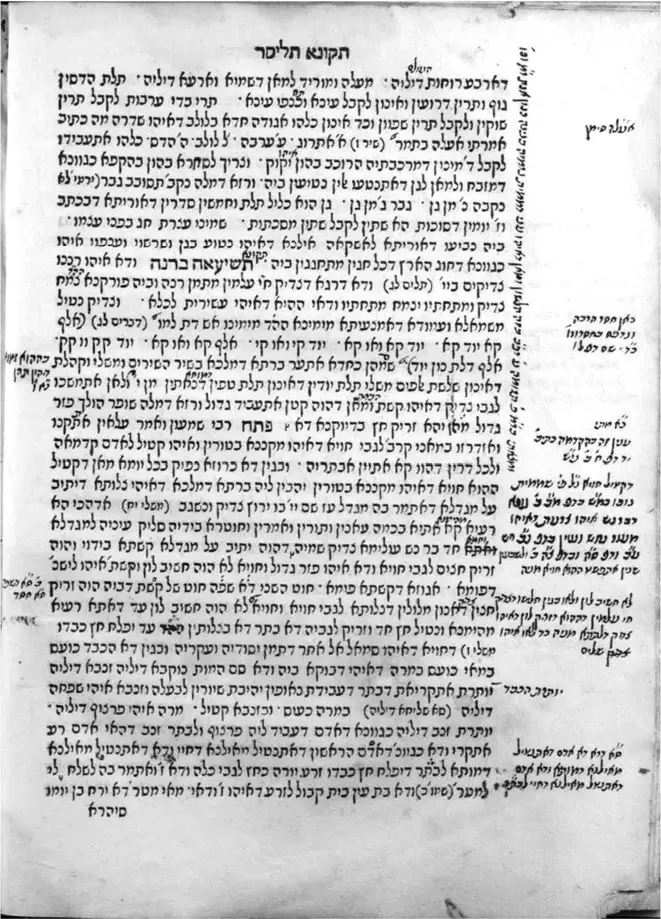
. Scholem Library R2141, renamed Ms. NLI 8° 6562,
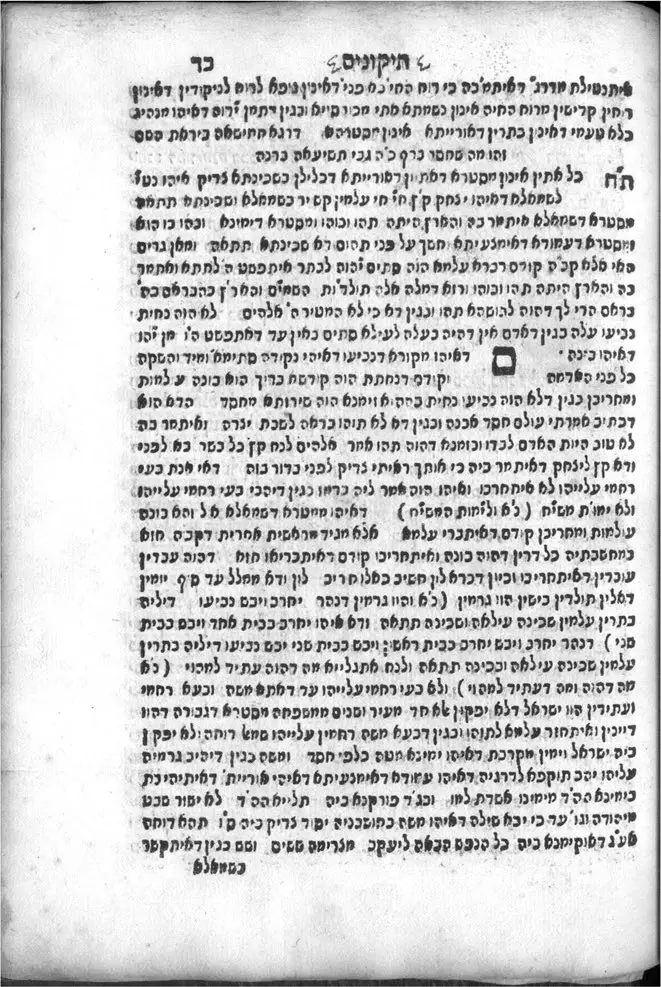
The claim that Vital’s *Lacunae* were the source of the collection known as the *Zohar Hadash* was once asserted by Daniel Frisch28Daniel Frisch, *Hashmatot ha-Zohar*, Jerusalem 2005, p. 7; idem, *Sha‘arei Zohar*, Jerusalem 2005, p. 163, citing *Shem ha-Gedolim* by R. Hayyim David Azualai. . Here, however, we have evidence that the printers in Salonika were putting the textual work undertaken in Safed into print. Di Lonzano also refers to *Hesronot ha-Zohar* in his *qissur seder ha-asilut*, Ms. Jerusalem NLI 28° 7991 fol. 127a (Avivi, p. 140) and in his handwritten marginal gloss in *Sha’ar Derush ha-Selem*, on folio 1a.
In the commentary on the Chukkat chapter, page 92, it is stated that the heroes come first, for she gave him a drink at the beginning from that, etc.; see there.
Jordan Penkower’s magnificent study of the textual work of de Lonzano and others of that period included examples of these29marginalia. Jordan Penkower, *Masorah and Text Criticism in the Early Modern Mediterranean: Moses Ibn Zabara and Menahem de Lonzano*, Jerusalem 2014. Joseph Avivi pointed out to me in a private correspondence that he had doubts as to whether this is de Lonzano’s autograph; I do not share these doubts.30 See also the marginalia in the Zohar ‘al ha-Torah, Mantua 1559, volume II, RR2146, which includes countless comments by Di Lonzano.
In any case, I would also like to mention that I once met a British collector who had another copy of it. He had come to the National Library of Jerusalem to conduct research on the subject, in order to corroborate his view that Di Lonzano had copied his notes there—a second copy of the Tiqqune Zohar. Setting aside for the moment the financial interests of this private collector, who wished to sell his copy at a higher price, I will note that I have seen other private copies of the Mantua Tiqqune Zohar containing some of these notes, even if they are not identical 31See the remarkable—if not whimsical and sarcastic—gloss on folio 9a. I also saw this commentary in a copy from Meir Benayahu’s library, and therefore it seems to me that one of the scholars sent his hand to alter the book, adding the phrase “and it shall be that he will bring you to be, if you listen,” but that is not the case. .
Di Lonzano wrote the comments in the copy of the Tiqqunei Zohar held by the National Library of Israel, but I understand that he copied most of the notes from another copy32Note the sentence on folios 77b, 93a, and 120a. The author said 39 . My interpretation, which I published in *Kabbalistic Manuscripts and Textual33Theory* by Daniel Abrams, *Kabbalistic Manuscripts and Textual Theory: Methodologies of Textual Scholarship and Editorial Practice in the Study of Jewish Mysticism*, with a foreword by David Greetham, Los Angeles and Jerusalem: Magnes Press, second revised edition, 2013, pp. 503–513, was that the interpolation of the marginal notes into the Mantua text reproduces the version of the third printing at Orta Koj, which was slightly corrected in the 1740 Constantinople printing and was subsequently reproduced in all later editions.
Given the greater amount of textual information available today, the interface between
manuscripts and printed works must be examined with greater precision. Furthermore, a copy of the second volume of the Zohar, Mantua, with Lonzano’s notes, was in Scholem’s collection—now RR126—and must be compared with his notes in the Tiqqune Zohar. Note the remark on the last folio 47a, where he commented that a passage from the Zohar, Genesis, Mantua 1558, fol. 121, corresponds to this passage in the Tiqqune Zohar. Furthermore, he notes that the Zohar, Genesis, folio 132 corresponds to the end of Tiqqun 122 on folio 89b; Genesis, folio 148, belongs to folio 92b, and Genesis, folio 134, belongs to folio 98a at the end of Tiqqun 57, according to a manuscript he consulted; Genesis, fol. 154 belongs to folio 103. He also writes that the passage from the Tiqqune Zohar, folios 83b–84a, rightfully belongs to Zohar al ha-Torah, Parashat Hayyei Sarah, Mantua 1558, fol. 311. All of this is to say that there was a body of commentaries in circulation, as well as a culture and tradition of textual criticism in and around Safed concerning the printed editions of the *Tiqqune Zohar* and *Sefer ha-Zohar ‘al ha-Torah*.
Safed served as the hub for the transition from manuscripts to printed texts. It is worth noting Tishby’s comment on the last printing of Zoharic texts in Thessaloniki: “The Zohar Hadash was not written [Tishby’s term might be better translated as ‘compiled,’ nithabber] at a later date, as some scholars have mistakenly believed.” It is a collection of fragments and complete works of Zoharic literature that were missing from printed editions, assembled from the manuscripts of the Safed Kabbalists and printed for the first time in Thessaloniki in 1597.” 34Tishby, *Wisdom of the Zohar*, p. 105, note 3. . Tishby’s commentary should be accepted and expanded upon. We would certainly not wish to call into question the scholarship and interest of the scholars of Thessaloniki in the Zohar, as demonstrated by Joseph Hacker’s numerous studies 35 Joseph Hacker,“A New Letter about the Controversy over the Printing of the Zohar in Italy,”*Masuot: Studies in Kabbalistic Literature and Jewish Philosophy, in Memory of Professor Ephraim Gottlieb*, ed. M. Oron and A. Goldreich, Jerusalem 1994, pp. 120–130 [Hebrew]; idem, “The History of the Study of Kabbalah and Its Dissemination in Salonica in the Sixteenth Century,” *Creation and Recreation in Jewish Thought: Festschrift in Honor of Joseph Dan on His Seventieth Birthday*, ed. R. Elior and P. Schafer, Tübingen 2005, pp. 163–180. . Undoubtedly, they were impressed by the unpublished manuscript materials that had come into their possession and responded to the call by printing a volume to supplement the Mantua editions. Nevertheless, the project was already functionally organized in Safed and by those connected to the textual work emerging from that center. And so, the significance of this phenomenon—as a textual and critical response to the manuscript comparisons of the Mantua printed text—should be shifted to Safed and attributed to the textual criticism undertaken by the Safed Kabbalists. So, what this marginal note adds to our understanding is that the Zoharic sources were not merely collated, and that the idea of editing the texts missing from the Mantua edition was first conceived in Safed, but that Vital himself apparently completed the textual work in manuscript form in a manner accepted as canonical according to a standard manuscript. We thus see the expansion of the canonical text in the manuscript even before the printing of additional volumes, but also after.
In a recently published volume, *Ohel Ra”M*, Moshe Hillel discussed a number of manuscripts of Vital’s commentaries on the Zohar. In a footnote spanning three pages, he expressed his astonishment at Avivi’s description of two separate discoveries of Hayyim Vital’s manuscripts in different vaults and at different times, buried in the Safed cemetery. 36Avivi, *Lurianic Kabbalah*, vol. 2, pp. 600–605. According to Hillel, Vital buried all his documents together—both Zoharic and Lurianic—in 1595 before leaving for Damascus. According to Hillel’s account, Abraham Azulai later discovered them all together sometime before 1618, but he used only the Zoharic manuscripts in the composition of his *Qiryat ’Araba*. The rest of the documents relating to Lurianic Kabbalah were transferred in one way or another in 1640 to Jacob Tzemah while Azulai was in Jerusalem. 37 Moshe Hillel, Ohel RA”M: Catalog of the Manuscripts in the Library of Rabbi Avraham Mordechai Alter of Gur, Jerusalem 2018, pp. 298–300, n. 410 [Hebrew]. . My goal here is not to offer an opinion on which theory is the most sound, but to emphasize how important it is today—just as it was back then—to scrutinize Vital’s research on the Zoharic doctrine based on his Lurianic writings. All of this is to say that while Vital may have been working on the Zohar before or concurrently with his writings on emanation from a Lurianic perspective, these projects were perceived as mutually exclusive, and this is what clearly troubled Joseph Avivi and Moshe Hillel, albeit for different reasons. In other words, the power and scope of Vital’s contributions to the textual criticism of the Zohar are so great that today, as then, they threaten the reputation of Vital’s identity as the principal author of the Lurianic corpus.
I would like to point out that Cordovero and Vital’s work on the Zohar is included only minimally in *Or ha-Hamah*, whereas Azulai incorporated all of Glanate’s *Zoharei Hammah* into that work. It is worth noting that Moses Zacuto reprinted the Zohar Hadash in 1653 in Venice—the third edition—following a page-by-page reproduction of the 1597 Salonika edition and the 1603 Krakow edition. He also printed *Derekh ’Emet* in Venice in 1663, which contains the notes, lacunae, and variants from the Mantua editions—including the *Tiqqune Zohar*—all attributed to Isaac Luria, but with the notable absence of any Lurianic speculation. 38 This book was printed without a title page. In his own copy, R2192, Scholem copied a title page from *Vinizia T’chai”h* in pen, based on a frontispiece he consulted at the JTS Library. See Carlo Bernheimer’s commentary, *Catalogue of Hebrew Manuscripts and Rare Books in the Talmud Torah Library of Livorno*, Livorno 1915, p. 118: “At the expense of Joseph Hamiz, correspondent of Rabbi Moses Zacut.” All known copies of this book lack a frontispiece; furthermore, the first leaf bears the number א=1. It is quite likely that the book never had a frontispiece, which should come as no surprise, since the book is as follows.” What unites all these efforts is a fascination with manuscript materials that are available only in Safed or that have passed through Safed. Thus, in contrast to the cultural agenda of segregating the textual work on the Zohar attributed to Luria and Vital, it can be said that the authority of these two figures operated in tandem, highlighted by the demonstration of their expertise as scholars and guardians of the correct readings of the Zohar, without reference to their new vision of Kabbalah. Academic research has strongly emphasized the interpretive innovation of the Safed Kabbalists regarding the Zohar—beginning with Luria and Vital—as a strong reaction to Cordovero’s restorative and conservative textual practices. Perhaps this should be reconsidered in light of the two distinct uses of the Zohar texts in the study programs of Luria and Vital 39Moshe Idel, “The Zohar as Exegesis,” *Mysticism and Sacred Scripture*, ed. S. T. Katz, Oxford 2000, pp. 87–101; Boaz Huss,“Zoharic Textual Communities of Safed,” Shefa Tal: Studies in Jewish Thought and Culture Presented to Bracha Sack, Beer Sheva 2004, pp. 149–169 [Hebrew]. .
Here, we should return to the observation made by the Mantua printers who, after working with various manuscripts from northern Italy, had to revise their texts in light of a manuscript that had come to them from Safed. Nothing in their remarks suggests that the Italian printers attributed any special status to the manuscript based on the cultural influence or authority of the Kabbalists active there. 40 On the relationship and cultural status of the figures and sources from these two regions, see Moshe Idel,“Italy in Safed, Safed in Italy: Toward an Interactive History of Sixteenth-Century Kabbalah,” *Cultural Intermediaries*; Jewish Intellectuals in Early Modern Italy, ed. D. Ruderman and G. Veltri, Philadelphia 2004, pp. 239–269. . In fact, there appears to have been no awareness of or contact between the two centers at that time. It was Moses Zacuto and Natan Shapira ha-Yerushalmi who would later seek to update the Italian editions with the authority of Isaac Luria. The trajectory thus runs from Italy to Safed and back, culminating in the Safedian response to the printing of the Zohar Hadash in Thessaloniki, which was expanded upon by Joseph Hamitz and Moses Zacuto when they reprinted this volume in Venice. In a forthcoming study, I will present the discovery of autograph marginalia, including Lurianic texts by R. Natan Shapira ha-Yerushalmi in a copy of the Venetian edition of the Zohar Hadash, which would later be interpolated into41subsequent editions. Daniel Abrams,“Textual Fluidity of the Zohar after its Printing—A Test Case for the Understanding of the Interface between Manuscript and Print (A High-Resolution Inquiry into the Marginal Glosses of R. Natan Shapira ha-Yerushalmi to Sefer Zohar Hadash, Venice 1658 from the Exemplar of the Oppenheim
Collection in the Bodleian Library,’ Kabbalah 41 (2018), pp. 143–242 [Hebrew]. . Thus, we could expand the earlier characterization—which described a flow from Italy to Safed and vice versa—to include the adoption of Ashkenazi interpretations in Italy and their subsequent return to Ashkenaz.
I would be remiss if I were to construct a singular or linear trajectory for the transmission of the Zohar or its literary formulation. For example, it is possible that other manuscripts from North Africa arrived in Safed, offering either a different set of texts or a different mix of readings. 42See Moshe Hallamish, *The Kabbalah in North Africa: A Historical and Cultural Survey*, Tel Aviv 2001, p. 15 [Hebrew]. See Solomon Alkabets’s request to the scholars of Fez, in which he asks them for manuscripts of the Zohar: “And furthermore, I appeal to you to do a great kindness for me and for those who study this awesome wisdom, namely: to inform the one whose name is Neb there of the number of the Zohar, for we have the entire Book of Genesis with us; I desire a commentary on each of its parashot, as well as the Book of Exodus and the Book of Leviticus; however, only a very small portion of each section of the Book of Numbers is present, and the sections “Mataot” and “Mas’ei” are entirely absent, nor is the book of Deuteronomy found, except for the portion of “Va’etchanan” and a very small portion in “Vayelech”; and in the books brought from there, we have not seen any new insights—perhaps they may be found in Dara and its environs. Likewise, the saying of Rabbi Elay and his sons with Rabbi Shimon bar Yochai, of blessed memory, and his companions in the Garden of Eden below—we find that portions of it are missing at the beginning and end, as well as in the middle of every section; likewise, in the book *Ha-Tikkunim* (ch. 54), there is nothing to refresh the soul. *Ginzei Yehudah*, ed. Yechiel Goldhaber, Jerusalem 2016, pp. 28–30.. In fact, the Zohar seems to have always been fluid, even though its reproduction in manuscript form during certain periods and in certain regions may give the impression of stability based on the agreement of a certain number of manuscripts. The printing of the Zohar sought to put an end to all disagreement regarding the multiplicity of textual forms and versions. But if that was its goal, it only served to trigger the production of more commentaries and texts that sought to delve back into the original text and its numerous gaps and variants that had been overlooked or excluded for one reason or another. The Mantua edition of the Zohar may have achieved its goal of being accepted and serving as the focal point of a long history of reception, but ironically, it has also become the canonical basis for a history of cataloging differences that has revised this text in numerous reprints and supplementary aids to its study.
Little has changed for the Zohar from the age of printing to our virtual world of hypertext and digital books accessible on the Internet. The textual imagination of those dedicated to printing—from Mantua to Stanford—demonstrates a commitment to producing a standardized text even when the Zohar is recognized as having been produced or having survived in multiple versions. In the introduction to the first volume of the Pritzker edition of the Zohar, Daniel Matt wrote that he began with the base text of the printed edition because it “represents a relatively reliable starting point,” to which he added “better readings” drawn from variants found in “several manuscripts and reliable witnesses.” 43The Zohar, vol. 1, pp. xvii–xviii. . The result is a revised version with clear text and notes on alternative readings, just as in the Mantua edition. Consequently, in Italy and California, the editors were aware that the differences between the manuscripts were not merely errors or corruptions due to transmission issues, but that at least two distinct textual variants existed, and they sought to produce a new and coherent work despite all this: “After a thorough analysis, I concluded that certain older manuscripts reflect an earlier recension of the Zohar, which was subsequently reworked in manuscripts of a later lineage.” 44ibid., p. xvi. . These methods share similar objectives and target audiences, and demonstrate that, 500 years later, both publishers chose to create a more readable and coherent text in the interest of their projects and goals, fully aware that the manuscript tradition does not contain just a single version or layout.
This could serve as a call to resume the work of determining what the Zohar was in each manuscript or branch across the various periods and regions of its transmission, leading to the construction of a history of “what the Zohar was,” and the many Zohars that have been published and read—rather than the singular Zohar that has become popular due to its printing. My call to scholarship, therefore, is to decentralize the Zoharic universe from any one first or latest printed edition and to reject claims based on a genitive history, a history of reception, or the production of a single critical edition to replace earlier editions. All of these seem to be projects grounded more in ideology than in methodologically rational explorations of texts that actually existed.
A few words to explain the historical patterns of transmission of Zoharic manuscripts and printed works that have shaped these editorial methods to the exclusion of others. Collections of Zoharic passages were already being copied by the end of the 13th century. They were combined with others to form larger compilations of texts, namely anthologies. The boundaries marking the literary limits of the passages were often lost because the texts were woven together into larger compilations, although some scribes noted the end of one of the multiple sources used in their codex, for example, עד כאן מצאתי.
Such notations are common in manuscripts of the Zohar, indicating in a later copy or anthology that the text is truncated or that sections are missing: כאן חסר.
Some manuscript anthologies include the same passage twice in different places, reflecting the incorporation of material from various sources and the absence of any accepted literary framework or program that guided the various manuscripts.
In the history of the Zohar’s transmission, transmission-related incidents have become established terms, and the text has been either corrupted or refined and polished into a consistent style, language, or spelling. As the 16th century approached—and particularly in the case of the printing of the Mantua edition, which was based on nine manuscripts from northern Italy
, and one from Safed at a later stage of the edition—it is clear that textual traditions were blended. The combination of distinct textual lines is known as “contamination,” but such contamination had already occurred in previous years. Printers sought to peel away layers of corruption—or at least differences or unwanted readings—in order to present the reader with a more perfect text. The flaw in this method is that by removing the contamination or apparent interventions in the text in order to uncover what is supposedly more original, they were in fact producing a text that never existed, confusing creation with restoration, and in effect producing yet another amalgam.
Printed editions of the Zohar have become canonical in one form or another. Rather than rejecting the printed version or commissioning a different edition, Kabbalists made changes to it in the form of glosses, lists of variants, and commentaries. Scholars have followed suit and have not, either, reverted to the pre-printing manuscript forms. Instead, manuscripts are viewed through the lens of the printed text, even when this is not explicitly stated. In both cases, the printed text and the manuscript have influenced one another, and no original plan has ever been faithfully executed. In this history of subsequent print editions, the interpolations in the glosses had been sporadic and inconsistent, so that even a printed edition corrected by Luria and his followers was never produced. Similarly, scholars have sought to revert the text to one of the latest descendants of the Mantua edition, solely to purge it of corrections based on multiple manuscript witnesses. The result therefore does not reflect any manuscript tradition.
The Zohar project will only be realized if one of the following two methods is implemented: either (a) a reprint of the revised Mantua edition, incorporating the complete textual criticism carried out within the Safed school of Kabbalists and by all subsequent generations who organized and expanded these commentaries, or (b) the preparation of editions based on discrete moments in the geographically situated history of the transmission of Zoharic manuscripts. As the study of this printed edition has shown, each edition is an edited document and incorporates both the older histories of the text and new editorial decisions. The three categories I have previously proposed for the study of the Zohar are most relevant here: the order of the text, its version or textual quality, and the identity of literary units. Certainly, in the case of the history of the reproduction and textual transmission of the Zohar, the interface between old and new editorial decisions is at play in the printed edition no less than in any manuscript witness. In this sense at least, there is no categorical difference for the serious study of the Zohar between a manuscript copy of the Zohar and a printed edition, which has become the blind spot of academic research.
Conclusion
The printing of the Mantua Zohar marks a pivotal moment in the history of the texts collectively known as the Zohar. Today, it can be said that Moses de Leon composed a book—quantitatively smaller than a commentary on the Torah—that is loosely identified by scholars as the Body of the Zohar. The book was scattered and reassembled into a compilation that included other Zoharic texts, and these collections became anthologies that developed unevenly, with copies circulating in Italy, Byzantium, and Safed. The printing of the Zohar in Mantua in four volumes was an attempt to recover and reconstruct the lost vision of the original book, but also to establish a new, singular text and a version of both the Tiqqune Zohar and the Sefer ha-Zohar ‘al ha-Torah. In the history of the Zohar, this became a unique moment in which the multiplicity and fluidity that had characterized the history of the texts’ earlier transmission, their reproduction, and their publication, came to a halt as the printers—acting as publishers—or the publishers—acting as printers—sought to establish a canonical text. Their hope was to standardize the text and produce a standard edition of a work that countless readers would read in a uniform edition, thereby putting an end to the various versions that were in the hands of different reading communities. These hopes were thwarted almost immediately because better sources and more learned readers protested against the supposed finality of the Mantua printing. Isaac Luria and Hayyim Vital, among others, wrote numerous commentary notes and filled in the margins with missing text that they knew from additional manuscripts. 45For example, see Ms. New York, JTSA 1015, where on the last page (143ab) an index of lacunae or hesronot ultimately attributed to Hayyim Vital states: “The young man said… Shmuel ben Ladoni, my father…” like Rabbi Hayyim Vital… All these omissions from the Zohar and the corrections from what was recorded up to what is written in the New Zohar—I did not write them. And the rest, which you will not find in the Zohar Hadash, I have written: Meir Benayahu,“Mishnat ha-Met (The Treatise of the Dead)” and“Seder Rehizah Gedolah (The Order of the Great Washing)” Attributed to Hillel the Elder, Jerusalem Studies in Jewish Thought 1:4 (1982), pp. 122–125 [Hebrew], which identifies the copyist as Shmuel, son of Hayyim Vital. Note a few examples from this index, which includes ma’amrei ze’ira—short passages, apparently additional unknown texts. See Moshe Hillel, Ohel RA”M, p. 261: Song of Songs from the Zohar—on folio 58; Omissions from the Midrash Ruth and Ne’elam—on folio 74; Midrash Eicha from the Zohar—on folio 79; Ma’amrei Ze’ira on folio 85;—Kav Ha-Mida—on folio 87; Omissions from the Tikunim—on folio 95; “The Secrets of the Letters from the Holy One, Blessed be He”—on folio 127; “Shortcomings from the Zohar”—on folio 135; “The Essay ‘And You Shall See’”—on folio 156. In this context, I should mention the manuscript of unpublished Zoharic passages, Ms. Moscow, Guenzberg 1827, which Ezra Chwat brought to my attention and which he and I will publish in a special study. .
Finally, some handwritten manuscripts of these Zoharic texts were printed in Thessaloniki in 1597 with explicit references to the pagination of the Mantua edition, paying homage to its canonical status while highlighting its flaws. The Zoharic corpus thus began with the four volumes of the Tiqqune Zohar and Sefer ha-Zohar ‘al ha-Torah and evolved into the expanded five-volume version we have today, which includes the Zohar Hadash. What is striking about the subsequent history of the Zohar’s printing and reprinting is that while its obvious flaws were acknowledged, its literary merit was never dismissed, and a new textual basis was chosen to reinvent the Zohar. In Amsterdam in 1715 and Constantinople in 1736, the Mantua edition was reprinted with the addition of notes and appendices drawn from what was available in Safed, while retaining the Mantua edition’s format and pagination. Like an archaeological tell that comprises the many layers of accumulation from all those who lived there, the editions of the Zohar display a mixture of different textual strands from various periods. Certain layers can, of course, be identified, but they are not necessarily arranged chronologically in such a way that each can be sequentially separated. 46 This is, in fact, a fascinating topic that deserves to be studied in its own right, both textually and culturally. Namely, why and for what reasons were texts added to the Zohar, particularly from other sources? Some initial observations have been made by various scholars, but this project remains a desideratum. Judah Zlotnick, *Ma’amarim*, Jerusalem 1939, p. 60. See also p. 40, note 2, where he discusses Zohar 1:22a: In the Vilna edition of the Zohar and in the vocalized edition, the text reads: “Da’ayahu olam ha-nivdalim.” And I have come to understand that these later expressions are nothing more than a haphazard addition, and this is what caused the variation in the text. And now that I have come across the first printed edition of the Zohar, from Mantua, I have indeed seen that there is nothing of the sort there—neither “the world of the separated” nor “the world of the distinguished”— and this alone suffices to show that anyone who bases his arguments on random expressions found here and there is simply mistaken—especially since we do not yet have a scholarly edition of the Zohar’s text itself. In his annotated Zohar, Sholem writes about this passage: “To the section on the Tikunim here!” The passage belongs not far from the beginning of Tikkun 70! What is missing in the continuation of the discussion before “the beginning” here is found in its entirety in the Zohar Chadash, page 110b below, and from this the matters are clarified, beginning on page 115b, line 11.The text before us (Gershom Scholem’s Annotated Zohar (Jozefow 1873), introduction by Yehuda Liebes, Jerusalem 1992). See also Scholem’s handwritten note on the Zohar III 274a: According to Rabbi Menachem Kasher (Sinai, Jubilee Edition, 5718, p. 51), this passage was copied into the Zohar, “Shulchan Arba,” by Rabbi Bachai ben Asher.
Zohar Talks, Episode 1: Moses Cordovero (the Ramak), with Eugene Matanky

Biblical Exegesis in the Zohar: Revisiting Wilhelm Bacher (1891)
Abraham Aboulafia: the discovery that anticipated modern mathematics by centuries

Heykhalot Zohar Peqoudey

Heykhalot Zohar Bereshit
