Cette publication est également disponible en :
 Français
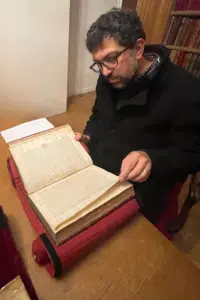
Avishai Bar Asher‘s speech
Colloquium The Kabbalah of Safed
Two exceptional manuscripts.
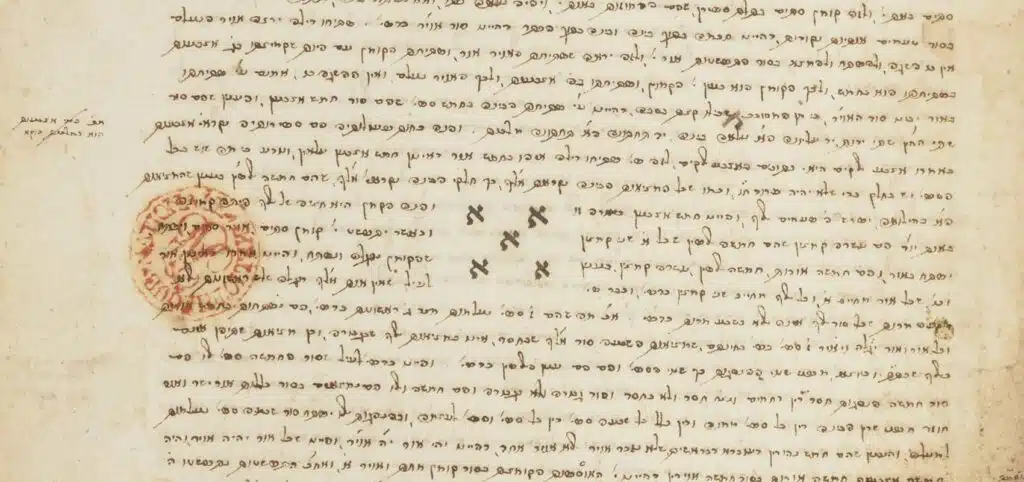
An international specialist in Kabbalistic texts and their history, Professor Avishai Bar Asher, who teaches in the Department of Jewish Thought at the Hebrew University of Jerusalem, presents the two manuscripts Hebrew 788 and Hebrew 789.
These manuscripts, commented on by the Kabbalist Moses Cordovero, were acquired in Italy by Jacques Gaffarel on behalf of Cardinal de Richelieu, then belonged to Gilbert Gaulmin before entering the collections of the BnF. Each of them is of great importance to the study of the history of Kabbalah from the early modern period to the present day. Like any good story, their curious narrative contains several chapters and its plot unfolds over several hundred years, through a variety of remarkable places and characters.
Avishai Bar Asher‘s presentation, co-hosted by Laurent Héricher and Michael Sebbanis followed by discussion and questions from the audience.
The Bibliothèque nationale de France (BnF) is a priceless treasure trove of knowledge and culture, housing unique collections that trace the intellectual and cultural history of humanity. Located on the Richelieu site, the BnF recently reopened its doors to the public after a decade of renovation work, offering renewed access to its precious collections. Among BnF’s jewels, the Hebrew manuscripts department stands out for its wealth and fascinating history. With over 1,500 manuscripts, this is one of the oldest collections in the library, bearing witness to centuries of Jewish history and the transmission of knowledge.
The conference organized at BnF highlighted two particularly remarkable manuscripts, Hebrew 788 and Hebrew 789, in the presence of specialists such as Professor Avishai Bar Asher of the Hebrew University of Jerusalem. These manuscripts, dating from the 16th century, are copies of a major work of Kabbalistic literature: Rabbi Moshe Cordovero’s “Or Yaqar” commentary on the “Zohar”, one of the fundamental texts of Kabbalah. These documents, which have survived the centuries, bear witness to the complex and sometimes secret transmission of mystical knowledge throughout the world.
The lecture delved into the history of these manuscripts, revealing details of their creation, transmission and preservation. The manuscripts were copied by scribes in Italy, shortly after Cordovero’s death, and passed through various stages of censorship and collection, passing from Jewish to Christian hands over the centuries. The study of these manuscripts is not limited to their textual content, but extends to their materiality, offering valuable clues to the historical and cultural context of their time.
The importance of the Hebrew manuscripts at BnF goes beyond the mere preservation of ancient texts. They provide a window on the intellectual and spiritual history of various eras, allowing researchers to immerse themselves in the theological, philosophical and mystical debates of their time. Preserving and studying these documents is essential to understanding the evolution of the ideas and traditions that have shaped human thought.
In conclusion, BnF plays a crucial role in preserving and promoting our cultural heritage. Through events such as this conference, it continues to promote research and the sharing of knowledge, making accessible the hidden treasures of human history. The Hebrew manuscripts, with their richness and complexity, are an eloquent example of the importance of these efforts, and of how they enrich our understanding of the past, while inspiring future generations.
–The manuscripts: Two volumes containing around 10% of Cordovero’s Or Yaqar commentary, copied in northern Italy shortly after the author’s death.
–Provenance and history: Manuscript 788, with a luxurious binding, comes from the collection of Cardinal de Richelieu, acquired by Jacques Gaffarel in Italy. Manuscript 789, with a simpler binding, belonged to Gilbert Gaulmin before arriving at the BnF.
–Codicology: Codicological analysis reveals original numbering, stamps from various libraries (Sorbonne, Bibliothèque Royale), annotations in Latin by librarians (including Gaffarel and Gaillet d’Ossentiel), and traces of Christian censorship.
–Copyist: The manuscripts were copied by a single 16th-century Italian Jewish scribe, probably Rabbi Ezra De Fano, a Kabbalist scholar in contact with the Kabbalists of Safed.
–Christian censorship: The manuscripts bear traces of Christian censorship, notably the deletion of the words “Goy” (gentile) and “Gilgoul” (transmigration of souls), as well as explanatory annotations by censors.
–Content and interpretation: Content analysis reveals information about Or Yaqar’s organization, copying practices and publication attempts. An example of Cordovero’s interpretation of a passage from the Zohar is presented, illustrating his method and original approach to the biblical commandment to return a lost object to its owner.