
Cette publication est également disponible en :
 Français

“TheHebrew Bible often refers to angels, and it takes an entire body of literature to understand what angels are. Biblical commentators throughout the centuries have offered various interpretations regarding angels—their names, their nature, and their functions.”
The best-known episode is undoubtedly that of Jacob’s dream, in which angels “ascend” and “descend” 1 (Genesis 28:12), but also that of the angels who came to visit Abraham:
“And he looked up, and there were three men”
(Genesis 19:2)
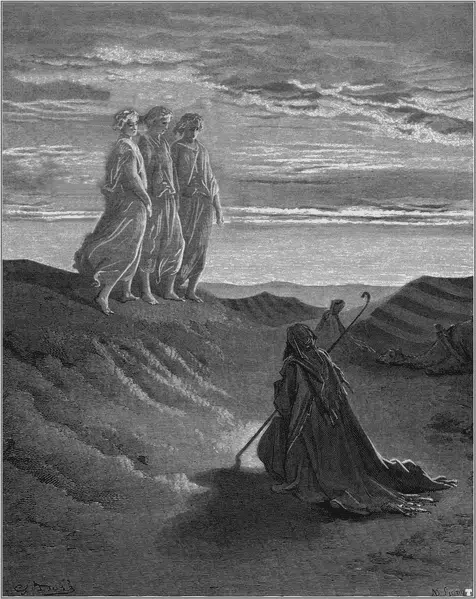
The verse refers to “three men,” but the Targum Jonathan translates it as: “Three angels in the likeness of men” 2 תְלָתָא מַלְאָכִין בִּדְמוּת גוּבְרִין . There are numerous examples throughout the entire biblical corpus, not to mention the Talmud, the Midrash, and the Zohar, and there are many books devoted to angels, including the one—in French—by Moïse Schwab.”
Moïse Schwab (1839–1918) was a scholar who served as Salomon Munk’s secretary but was best known as the author of 87 works, including a complete translation of the Jerusalem Talmud and a one-of-a-kind work in French entitled “Vocabulary of Angelology Based on the Hebrew Manuscripts of the National Library” (3 Published: Paris: C. Klincksieck, 1897), which was followed two years after its publication by a 50-page supplement 4 (Published: Paris: C. Klincksieck, 1899. The writing of this work thus spanned many years and provides the French reader with a veritable encyclopedia of biblical angelology.
There are, of course, other works on this subject, which we will discuss again soon ב׳ה, but Mr. Schwab’s is very interesting. Organized alphabetically, it lists the occurrences and etymologies of the names of the angels, as well as numerous references drawn from the Talmud, the Midrash, and the Zohar. Here is the text:
