Cette publication est également disponible en :
 Français


For while I am not very familiar with Freud’s psychoanalysis or Jung’s, I have, on the other hand, studied Kabbalah in the *Zohar* in great detail.
Antonin Artaud
One of the most striking features of Christians’ complex attitude toward Jews and their books in the mid-16th century is the ambivalence of their policy regarding, for example, the banning and persecution of certain Jewish books, notably the Talmud, and the fascination with—and even promotion of—other equally Jewish intellectual works, such as the Zohar. It is quite striking, as I have already pointed out on a previous occasion 1 S. Campanini, On Abraham’s Neck: The First Edition of the Sefer Yetzirah (Mantua, 1562) and Its Context , in G. Veltri and G. Miletto (eds.), *Rabbi Judah Moscato and the Jewish Intellectual World of Mantua in the 16th–17th Centuries*, Brill, Leiden–Boston 2012, pp. 253–278. , to read the report by Sixtus of Siena, who had been sent to Cremona to burn the Talmud—which he did with devastating success. At the same time, as we have also read in his excellent *Bibliotheca Sancta*, upon coming across stacks of newly printed copies of Vincenzo Conti’s edition of the *Zohar*, he was proud to announce that he had managed to save them from the imminent risk of destruction by the Spanish soldiers occupying the city. One cannot help but feel as though one is witnessing the unfolding of a certain paradigm of substitution 2 See A. Raz-Krakotzkin, The Censor, the Pen, and the Text: The Catholic Church and Hebrew Literature in the 1960s , The Magnes Press, Jerusalem 2005; English translation (by J. Feldman) The Censor, the Editor, and the Text: The Catholic Church and the Shaping of the Jewish Canon in the Sixteenth Century , University of Pennsylvania Press, Philadelphia, 2007. , alternating between brutal repression and smooth flattery to eradicate one body of texts and promote another—to promote the Zohar over the Talmud as an alternative deemed capable of bringing about, or at least facilitating, the conversion of Jews to Christianity. Even when toning down the polemical exaggerations of Heinrich Graetz, who defined the Zohar as a“Schosskind des Papstes” 3 P. Schäfer, “Adversus Cabalam” or Heinrich Graetz and Jewish Mysticism, in P. Schäfer and I. Wandrey (eds.), Reuchlin and His Heirs: Researchers, Thinkers, Ideologists, and Eccentrics , Jan Thorbecke, Ostfildern 2005, pp. 189–210; but see G. Y. Kohler, “Heinrich Graetz and the Kabbalah,” in *Kabbalah* 40 (2018), pp. 107–130. See also G. Y. Kohler, Kabbalah Research in the Wissenschaft des Judentums (1820–1880). The Foundation of an Academic Discipline , De Gruyter, Berlin–Boston 2019, and the review by the current author in *Materia Giudaica* XXIV (2019), pp. 655–657. (a favorite of the Pope), one question still deserves to be asked: given that Christians’ disparagement—or even hostility—toward the Talmud has a long and tragic history, where does this preference for the Zohar come from? Furthermore, what did Christians know about the Zohar before it was printed, given the clear involvement of Christians in authorizing its printing and even financing it?
This essay aims to provide the building blocks for a plausible answer to this question by examining the history of the Christian attitude toward the Zohar, following in the footsteps of the pioneering work written in the 1950s by François Secret 4, F. Secret, *Le Zôhar chez les Kabbalistes chrétiens de la Renaissance*(Durlacher, Paris 1958); this book was reprinted, unchanged, in 1964 (Mouton, Paris). and, of course, following in the footsteps of the most important recent work devoted to the history of the Zohar by Boaz Huss 5 B. Huss, Ke-Zohar ha-Raqia‘. Chapters on the History of the Reception of the Zohar and the Establishment of Its Spiritual Foundation , Makon Ben Zvi – Mossad Bialik, Jerusalem 2008; English translation by Y. Nave, The Zohar: Reception and Impact , The Littmann Library of Jewish Civilization, Oxford–Portland 2016. , in search of the earliest evidence of some familiarity with the Zohar among Christians. This preliminary research is necessary to explain a rather striking phenomenon: the decade following the burning of the Talmud in 1553 and the forced closure of Hebrew printing presses in Venice was not, as one might have expected, a barren wasteland of repression and inactivity, but rather a unique “window of opportunity,” to borrow an expression already used in another era by Moshe Idel 6 M. Idel, “The History of Kabbalah, 1270–1290,” in *Daat* 48 (2002), pp. 5–32; English version: “The Kabbalah’s ‘Window of Opportunities, ’” in E. Fleischer (ed.), Me’ah She‘arim: Studies in Medieval Jewish Spiritual Life in Memory of Isadore Twersky , Magnes Press, Jerusalem 2001, pp. 171–208. , and a period of flourishing. Just as the silence of the Venetian printing presses led to the expansion and extraordinary success of printing presses located in other cities of northern Italy—I mention here Mantua, Cremona, Sabbioneta, and Riva di Trento—so too, the violent suppression of the Talmud and Talmudic literature did not coincide by chance with the spread of the Zohar and Zoharic literature, which was to have a decisive influence on the development of Jewish culture at the dawn of the modern era 7 See G. Busi, “Materials for a History of Kabbalah in Mantua,” in *Materia Giudaica* 2 (1996), pp. 50–56; Ibid., Mantova e la qabbalah / Mantua and the Kabbalah, Skirà, Milan 2001. .
At the same time, like the beautifully reproduced copy of the Mantua edition of the Zohar 8 I am referring to the three facsimile volumes ofthe editio princeps ( Mantua, 1558) from the collection of Elie J. Nahmias, now housed at the Library of the Alliance Israélite Universelle in Paris, published in 2018 by Beit ha-Zohar in collaboration with Éditions de l’éclat. , among many others, amply demonstrates that Christians did not consider the Zohar entirely acceptable without interventions, corrections, or outright censorship: the copy held by the Alliance Israélite Universelle, for example, bears the signatures of four censors: Domenico Gerosolimitano and Alessandro Scipione (both in 1597), Giovanni Domenico Carretto (1617), and Vincenzo da Matelica (1622) 9 See W. Popper, *The Censorship of Hebrew Books*, The Knickerbocker Press, New York 1899 [reprinted by Ktav, New York 1969], pp. 102 and 146. and, in accordance with the *Sefer ha-Zikkuk*, it also contains erasures and redactions throughout its three volumes. This case differs only in appearance from that of the *Tiqqune ha-Zohar*, published in Mantua in 1556, of which, thanks to a handwritten annotation by Vittorio Eliano 10 Campanini, *On Abraham’s Neck*, op. cit., p. 255. , we know that the censorship process took place before publication; thus, it was unnecessary—at least according to the censors—to revise the book again after it had been printed. Of course, any act of censorship is more effective if it is not immediately visible.
I am convinced that the complex attitude of Christians toward the Zohar—which led to outcomes as contrasting as its publication, promotion, and even preservation on the one hand, and its censorship on the other, can only be understood against the backdrop of the spread of the Zohar (and its pseudo-versions) among Christians in the fifteenth and sixteenth centuries. From the very beginning, in fact, one can easily identify two trends that characterize the entire history of the Christian perception of Jewish literature between the Middle Ages and the Renaissance. On the one hand, there is the tendency to exploit both authentic and forged passages of Jewish literature, purporting to confirm the truth of Christianity in order to support the sustained effort to convert Jews to Christianity. This trend is epitomized by the title of the most influential compendium and anthology of Jewish texts (both authentic and forged) intended for use in preaching and polemics: the *Pugio Fidei* 11 G. K. Hasselhoff and A. Fidora (eds.), Ramon Martí’s *Pugio Fidei*. Studies and Texts , Obrador Edendum, Santa Coloma de Queralt, 2017. For the disputed authenticity of some of these texts, see S. Lieberman, Shkiin. A Few Words on Some Jewish Legends, Customs, and Literary Sources Found in Karaite and Christian Works (including an Index of the Jewish books cited in Raymund Martini’s *Pugio Fidei*) , Bamberger & Wahrmann, Jerusalem 1939. . On the other hand, in a similar yet distinct vein, we see the spread—especially toward the end of the 15th century—of a Christian fascination with Kabbalah, always from the perspective that it was entirely compatible with the Christian faith but without any particular emphasis on the conversion of Jews. Christian Kabbalists of the Renaissance seemed rather convinced that Christians should learn Hebrew in order to read Kabbalistic texts, from which they expected unique spiritual benefit, moral edification, and even mystical revelations. The two attitudes are clearly intertwined, so that it is not always easy to keep them separate; one could even argue that the perspective of Christian Kabbalah represents an evolution of the foundation laid by the literature of the *Pugio Fidei*; however , since I am convinced that the elements of rupture outweigh the obvious continuities 12 See S. Campanini, “The Birth of Jewish Studies from the Spirit of Christian Kabbalah,” in G. Veltri and G. Necker (eds.), Gotte’s Language in the Philological Workshop: Hebrew Studies from the 15th to the 19th Century , Brill, Leiden–Boston 2004, pp.135–145. , I will attempt to paint a more nuanced picture in the following discussion.
In reviewing the vast array of early Christian references to and quotations from the Zohar, one might be tempted to draw a distinction between “authentic” and “falsified” references to the Zohar and to derive from this philological criterion a theological nuance, separating the polemicists who were interested—using dubious means if necessary— to achieve the conversion of Jews at any cost, from the forerunners of Jewish studies, who would rather have lost a few Jewish souls in order to attain a true and accurate understanding of the reality of Jewish tradition—so as to convince their Christian brothers of its inestimable value in confirming the truth of Christianity. The distinction between a polemical tool (ad extra) and true prophecy (ad intra) does not, however tempting it may seem, the correct historical framework for understanding the phenomenon we are facing, nor is it the right path leading us to grasp the intellectual context that enabled and even fostered the printing of the Zohar in the second half of the 16th century in Italy.
The very concept of “forgery” does not apply very well in the case of the Zohar, which has been repeatedly denounced as a forgery in and of itself—not only because of its pseudo-epigraphic nature, but also for the simple reason that prior to its canonization—which only partially coincided with its appearance in printed form, since, as with any other canonical text, the paralipomena and apocrypha continued to be copied and, in due course, would also be published— there was no normative “Zohar” that would make it easy to decide whether a “new” Zoharic text should or should not be considered part of Zoharic literature. In fact, even after the publication of the Zohar, the scholar ‘Azariah de Rossi 13 See A. De Rossi, *The Light of the Eyes*, translated from Hebrew with an introduction and annotations by J. Weinberg, Yale University Press, New Haven–London 2001, pp. 116–117; J. Weinberg, “The Quest for Philo in Sixteenth-Century Jewish Historiography,” in A. Rapoport-Albert and S. J. Zipperstein (eds.), Jewish History: Essays in Honor of Chimen Abramsky , Peter Halban, London 1988, pp. 163–187: 171; G. Veltri, Renaissance Philosophy in a Jewish Context: Foundations and Challenges in Judaism on the Eve of Modernity , Brill, Leiden–Boston 2009, p. 90. could accept as plausibly authentic, albeit with a note of doubt (“if they really wrote it that way”), a well-known passage—which we will discuss further in the following pages—that apparently confirms the Trinitarian interpretation of the “Sanctus” or Trishagion from Isaiah 6 14 See S. Campanini, Id., Nottole in Athens: Christian Kabbalah and the Conversion of the Jews , in *Materia Giudaica* XIX (2014), pp. 81–101. . De Rossi merely noted that this would be nothing more than a terminological discrepancy, provided one did not “cross the line” and attribute corporeality to the Divinity. After all, he continues, the sage Recanati wrote statements very similar to this; in other words, there was no need to reject the Trinitarian reading of the Sanctus as false. If we consider that Yehudah Liebes 15 Y. Liebes, “Christian Influences in the Zohar,” in Id., *Studies in the Zohar*, State University of New York Press, New York 1993, pp. 139–161; in Hebrew, Hashpa‘ot notzriyot ‘al sefer ha-zohar, in “Jerusalem Studies in Jewish Thought” 2 (1983), pp. 43–74. is inclined to believe that the “normative” passage in question may have been censored by Jews in order to prevent its Christianized interpretation, it is evident that the Zohar’s unstable textual situation before and after its publication has largely opened the door to divergent, even opposing, hermeneutical interpretations.
Nevertheless, contrary to what Scholem was inclined to believe 16 See G. Scholem, “On the History of the Beginnings of Christian Kabbalah,” in Essays Presented to Leo Baeck on the Occasion of His Eightieth Birthday, East and West Library, London 1964, pp. 158–193; Revised French version; “Reflections on the History of the Beginnings of Christian Kabbalah,” in A. Faivre and F. Tristan (eds.), Christian Kabbalists, Albin Michel, Paris 1979, pp. 19–46; English translation: *The Beginnings of the Christian Kabbalah*, in J. Dan (ed.), The Christian Kabbalah: Jewish Mystical Books and Their Christian Interpreters , Harvard College Library, Cambridge, Mass., 1997, pp. 17–51. , the first mention and the first two citations from Zoharic literature in a Christian context are not forgeries created by a Jewish convert—a figure who, to use the image coined by Johann Widmannstetter and much appreciated by Scholem,17 On Scholem’s attitude toward Christian Kabbalah, see S. Campanini, “Some Notes on Gershom Scholem and Christian Kabbalah,” in J. Dan (ed.), Gershom Scholem: In Memoriam, vol. II, “Jerusalem Studies in Jewish Thought” 21 (2007), pp. 13–33. , the Trojan horse18 See F. Secret, “A Trojan Horse in the Church of Christ: Christian Kabbalah,” in *Aspects of Libertinism in the16th Century*, Vrin, Paris 1974, pp. 153–166: 160–161. , neither among the Jews nor among the Christians. To the best of my knowledge, the very first citations from the Zohar are found in the *Contra Iudaeos*, or *Tractatus de conflictu Christianorum contra infideles*, in three books, completed in 1397 and written by Maestre (Juan) Pedro Figuerola 19, F. Secret, “Les Annotationes decem in sacram Scripturam de Petrus Antonius Beuter,” in *Sefarad* 29 (1969), pp. 1–14. . For a long time, little was known about this polemicist, not even his name (Joann or Pedro), but it seems quite likely that Klaus Reinhardt is correct in assuming that he was a physician, most likely of Jewish origin, who, in the wake of the campaign led by Vicente Ferrer in 1391, was commissioned by King John I of Aragon to examine the books of the Jews of Valencia along with three Franciscans 20 K. Reinhardt, Hebrew and Spanish Bibles on the Inquisition’s pyre. Texts on the history of Bible censorship in Valencia around 1450 , in *Historisches Jahrbuch* 101 (1981), pp. 1–37: 12–14; K. Reinhardt and H. Santiago-Otero, *Biblioteca bíblica ibérica medieval*, Consejo Superior de Investigaciones Científicas, Madrid 1986, pp. 263–264. . The treatise is, like the nearly contemporary *Victoria Porcheti* by the Genoese Carthusian Porchetto dei Salvatici, a reworking of the *Pugio Fidei*, with the most interesting addition of two quotations from the Zohar, which he must have known from a different source—either through his personal knowledge of a manuscript containing one of the many versions of the Zohar in circulation or through documents handed over or confiscated from the Valencian Jews. His treatise, unlike Victoria Porcheti’s, was not printed, but it had a distinguished readership, especially locally, since the polemicist Jaime Pérez of Valencia, in his *Tractatus contra Judaeos*, published in Valencia in 1484, respectfully cites his Valencian colleague 21 See W. Werbeck, Jacobus Perez of Valencia. Studies on His Commentary on the Psalms , Mohr Siebeck, Tübingen 1959, p. 20. , and again, in the 16th century, the distinguished exegete Pedro Antonio Beuter, also from Valencia, mentions him and quotes him with praise in his *Annotationes decem in Sacram Scripturam* (Valencia, 1547). 22 *Secret*, *Annotationes decem*, op. cit. Figuerola’s treatise, at least in part, was preserved not only in Valencia, at the Cathedral Library—where three volumes are still held— but also at the Inguimbertine Library in Carpentras, a sign of the treatise’s circulation among 17th-century libertines such as Nicolas Fabri de Peiresc and Jacques Gaffarel. The two quotations, as Chen Merchavia has shown 23 Ch. Merchavia, “Shte muva’ot min ha-midrash ha-ne‘elam bi-ktav yad latini,” in *Kirjat Sefer* 43 (1968), pp. 560–568; cf. Id., “Note on Quotations from the Zohar in Latin Manuscripts of Anti-Jewish Polemics,” in “Sefarad” 31 (1971), p. 104. , are taken from the Midrash ha-ne’elam and were first published in the original Hebrew in the Zohar Chadash— that is, as late as 1597 24 For a modern edition of these passages, see Zohar Chadash, Mossad ha-Rav Kook, Jerusalem 1994, pp. 2d and 25b; for the English translation, see N. Wolski (ed.), The Zohar, vol. X, Stanford University Press, Stanford 2016, pp. 7 and 295–296. . Even the original Hebrew of these quotations, however, had been preserved—albeit in only one manuscript (at the El Escorial Library near Madrid)—among the hundreds of quotations collected by the convert Alfonso de Zamora in his *Sefer Chokmat Elohim*, published in Spanish. Translated by Federico Pérez Castro 25 F. Pérez Castro, The Apologetic Manuscript of Alfonso de Zamora: Translation and Study of the Sefer Ḥokmat Elohim , Spanish National Research Council, Madrid–Barcelona 1950, pp. 81–82; 181–182. and, since they coincide perfectly with their Latin translation in both manuscripts of Figuerola’s *Contra Iudaeos*, it must be surmised that Zamora, in 1532, had access in Alcalá to the original source of Figuerola’s quotations—whether it was Figuerola’s source material or his own compilation, in the original or as a copy. As Pérez Castro has shown, the two quotations are used to confirm, with new material, two arguments presented in the *Pugio Fidei*: one concerning the identification of the Messiah with the stone (אבן, eben) and the other concerning the punishment of the wicked in the seven regions of Hell. It could not be more evident that the first Christian encounter with the Zohar, dating from the late 14th century, is fully reflected in the project of the *Pugio Fidei* ( to convert the Jews through their own literature, in the aftermath of the Barcelona Disputation), the texts are “authentic,” and their purpose is, as Alfonso de Zamora put it—with an obvious play on words: כְּדֵי לִתְפּוֹשׂ מְשׁוּבַת הַעִבְרִים שְׁהֵם עִִוְרִים, “To facilitate the conversion of the blind Jews,” playing on the homophony between “blind” ’ (‘iwrim) and ‘Jews/Hebrews’ (‘ivrim) 26 As can be seen in Escorial G I 8, f. 1r. See Pérez Castro, *El manuscrito*, op. cit., p. 1. . One point is thus established: the Zohar, with its extensive collection of rabbinic sources, could be used as a valuable tool for converting Jews, thereby justifying the effort to seek it out, study it carefully, and even preserve it. in the arsenal of weapons for the controversy with the Jews and for persuading them to embrace Christianity and receive baptism.
The second instance of the Zohar appearing in a very similar context is the well-known—or, should I say, notorious—quotation found in *Zelus Christi* by the convert Pedro de la Caballeria, compiled in 1450 but printed much later in Venice in 1592. Once again, the broader context of this quotation is an official religious trial, this time held in Tortosa, which led to the conversion of the prestigious de la Caballeria family. Everything Pedro has to say about the Zohar is of extreme interest to our discussion: he states that the entire work, called “Cefer Azohar,” is very voluminous (liber magni voluminis) and full of great secrets (magnorum secretorum), written in Aramaic ( scriptus Caldea lingua), and is found among certain Jews (peculiares Judaeos) in the Kingdom of Castile. Furthermore, he honestly admits that he was unable to see the entire book (Ego non vidi totum librum), but only a single notebook. This is a pattern that will characterize the entire reception of the Zohar: the tension between the brief portions of text that someone has seen or possesses, and the “complete” Zohar—the great, mysterious book—which is always to be found elsewhere, in someone else’s possession, in the hands of yet another person. The myth of the complete Zohar—which alone could provide the definitive unveiling of the partial and fragmentary secrets it contains in such abundance—already influences the earliest stages of the Zohar’s dissemination through the archetypal scene described in a biography of Isaac of Acre, in which the widow of Moshe de León and her daughter, dashing “the horizon of expectation,” reveal that the “complete” Zohar—or its Vorlage—existed only in Moshe de León’s mind 27. G. Scholem, *Major Trends in Jewish Mysticism*, Schocken Publishing House, Jerusalem 1941, pp. 186–187. It is also well known that in the first decades following the “publication” of the Zohar, numerous imitations were produced, and some of them were incorporated into the main corpus of the Zohar. It is interesting to note that, precisely at the time when the “myth” of the “entire Zohar” was introduced into the Latin world and into a polemical treatise, of the two quotations supposedly produced by Pedro de la Caballeria, one—concerning the equivalence between“Binah,” the third sefirah, and its anagram“Ben Yah”—Son of Yah or“Filius Dei”—can be considered authentic, since it appears in numerous passages of the Zohar; the other, the main one, does not appear verbatim in the printed Zohar, nor, for that matter, in any known manuscript of this tantalizing collection of fragments. This is the first known occurrence of a very apt (pseudo-)Zoharic maxim: “Sanctus de 28 I am correcting the reading in the printed edition (“David”), which is certainly erroneous. Abba, sanctus Dabera, Sanctus da Ruha de Cudsa 29 P. de la Cavalleria, *Tractatus Zelus Christi contra Iudaeos, Sarracenos et infideles*, published by Baretium de Baretiis, Venice 1592, p. 34r; see also p. 111v. For a list of authors who cite the same passage, see Campanini, *Nottole ad Atene*, op. cit., p. 88. “. The existence of a mythical ‘complete’ Zohar made it impossible for anyone to refute the authenticity of this forgery or any other forgery, since any given copy of the Zohar that might be produced could always be suspected of being incomplete. Here, almost at the very time of the introduction of printing in Germany and a few years before the printing of the first Hebrew book, we would have an excellent argument (from a Jewish perspective) in favor of printing the Zohar, in order to establish, at least in hindsight, a normative Zohar, in order to halt the proliferation of imitations and apocryphal works of all kinds, whether Jewish or—even more dangerously—Christian.
In fact, although the *Zelus Christi* remained unpublished in its own time, this fragment and other “Zoharic” fragments found their way into print and were widely circulated. According to Abraham Farissol’s later account, there was even a society of Spanish conversos that produced a collection of fake Zoharic texts blatantly affirming the main tenets of the Christian faith in a mocking imitation of the Zohar’s Aramaic style 30 Scholem, *The Origins of Christian Kabbalah*, op. cit., pp. 187–193; D. Ruderman, The World of a Renaissance Jew: The Life and Thought of Abraham ben Modecai Farissol , Hebrew Union College Press, Cincinnati 1981, pp. 47–49. . In 1487 or 1488, yet another Spanish Jewish convert, Pablo de Heredia—who was in contact with the Dominicans and familiar with the *Pugio Fidei* literature—reports that, after receiving a small book, as he recounts, from a certain Rabbi Abraham Papur in Jaca (Aragon), containing marvelous secrets and astonishing prophecies confirming that Jesus was the Messiah, published the *Epistola de Secretis* in Rome, confirming the Zoharic passage cited in the *Zelus Christi* and adding another—equally insightful—passage that interpreted, in a Trinitarian manner, the authentic wording of the Zohar regarding the“Shema” from Deuteronomy. 6 31 See Campanini, *Nottole ad Atene*, op. cit., pp. 88–90. . The *Epistola* was certainly widely read, but its impact was limited when compared to the enormous circulation achieved by the *De arcanis catholicae veritatis* by the Franciscan Pietro Galatino, printed in Ortona a Mare by Gershom Soncino in 1518. This voluminous treatise, which rephrased the main content of the *Pugio Fidei* for a wider audience , was not only reprinted several times during the 16th century and the first half of the 17th century—until the *Pugio Fidei* itself was finally printed, first in Paris (1651) and then in Leipzig (1687)—but it was also cited in virtually all polemical writings against the Jews from the 16th to the 19th century. Among the many texts reprinted by Galatino in his work, Heredia’s pseudo-Zoharic passages occupy a prominent place and thus reach a much wider readership 32 S. Campanini, Almost immediately after the harvest, gathering the grapes. Pietro Galatino and His Defense of Christian Kabbalah , in W. Kühlmann (ed.), Reuchlin’s Friends and Foes: Communicative Constellations of an Early Modern Media Event , Jan Thorbecke Verlag, Ostfildern 2010, pp. 69–88. . Galatino, who knew full well that no Jew would confirm the presence of the Trinitarian interpretation ofthe “Shema” in the “authentic” Zohar, was quick to cite—as the convert Paulus Riccius had already done before him in 1507— 33 See P. Riccius, *Sal foederis*, Jacob de Burgofranco, Pavia 1507, ff. 38v–39r. Secret, *The Zohar*, op. cit., p. 27. , Menachem Recanati’s Commentary on the Pentateuch, in which one might find a “preemptive” explanation for any censorship the Jews may have imposed on their copies of the Zohar. Recanati, in turn, had referred to a passage in the Zohar in which Rabbi Shimon ben Yochai had warned that specific secrets concerning the“Shema” prayer would be revealed only after the coming of the Messiah 34 M. Recanati, *Perush ‘al ha-Torah*, vol. II, Amnon Gross, Jerusalem 2003, p. 15. The reference, for its part, is to the Zohar III 136b. . Furthermore, he anticipated the objection by stating that, whatever the Jews might claim, he himself had seen in Lecce, before the general expulsion of the Jews from southern Italy in 1510, while consulting a very old Hebrew book in which another disputed passage from the Targum was said to contain a Trinitarian explanation of Isaiah’s Trishagion 35 P. Galatino, *De arcanis catholicae veritatis*, G. Soncino, Ortona a Mare 1518, f. XXXIr: “In the very oldest books, which are exceedingly rare, it is indeed recorded exactly as I have recounted. I myself saw one of these books when I was in Lycia, at a time when the Jews were being expelled from the entire Kingdom of Naples by order of the Catholic King.” . In other words, if the texts he cites are not found in Jewish sources, this must be the result of a censorship campaign carried out by the Jews to avoid the embarrassment caused by such authoritative confirmations of Jewish dogmas. It can be said with certainty that no other polemical work has done more to spread among Christians the idea that the Zohar, if it were complete and properly understood, would, once printed, be a formidable resource for the conversion of Jews. To be entirely honest, voices were raised against this astonishing “ confirmatio catholica ”: how could these texts be authentic and “canonical” among the Jews yet so ineffective, since the Jews denied their authenticity and were neither impressed by them nor motivated to embrace Christianity? Even Pope Paul III had to express some apprehension, but Galatino reassured him in a letter, in which he stated that the original Hebrew text from Heredia’s source was in his possession and that he would translate it again 36. A. Keleinhans, De vita et operibus Petri Galatini, in “Antonianum” 1 (1926), pp. 145–179; 327–356. Since the passage from the *Zohar* commenting on Deuteronomy was not found in the *Gale Razaya*, Heredia’s main prophecy, but in the *Postillae*, the presumed original was even more elusive—until, as is hardly surprising, it was fabricated. In due course, first in a very poor Hebrew version found in Giovanni Maria Vincenti’s apologetic work *Il Messia Venuto* (1659) 37 G. M. Vincenti, *Il Messia venuto*, vol. I, Girolamo Bragadin, Venice 1659, p. 79; see Campanini, *Nottole ad Atene*, op. cit., pp. 92–93; 96–98. , and much later retranslated into a dubious form of Aramaic by the notorious convert and forger Juan Joseph Heydeck in his *Defensa de la religión Cristiana* (1793) 38 G. M. Vincenti, *Il Messia venuto*, vol. I, Girolamo Bragadin, Venice 1659, p. 79; see Campanini, *Nottole ad Atene*, op. cit., pp. 92–93; 96–98. .
Alfonso de Zamora, whom we have already mentioned, copied—as we have seen—authentic passages from the Midrash ha-ne’elam, and could not resist quoting in his bilingual apologetic letter to the Jews of Rome (published as an appendix to the second edition of his Hebrew Grammar, which appeared in Salamanca in 1526), with only minor variations, the Trinitarian Trishagion 39 A. de Zamora, *Introductiones Artis grammatice Hebraice nunc recenter edite*, published by Michael de Eguia, Complutum 1526, f. CC4r. See Pérez Castro, *El manuscrito*, op. cit., p. LXXII; F. Secret, *Les kabbalistes chrétiens de la Renaissance*, Archè, Milan 1985, p. 219; F. J. Perea Siller, “Los inicios de la cábala humanista en Alcalà: Alfonso de Zamora and Cipriano de la Huerga, in “Helmantica” 191 (2013), pp. 153–180: 163–164.
Kaddish Avah, Kaddish Berah, Kaddish Ruach D’Shmaya
One of the most striking features of the numerous citations of the Zohar in Christian polemical literature between the late 15th and the first half of the 16th century—though already evident as early as Pedro de la Caballeria—is the coexistence of “authentic” and “falsified” Zoharic texts .” Alfonso de Zamora, in fact, is certainly not the only one in this category: the Emperor’s influential physician, the aforementioned Paulus Riccius, cites in several of his works both authentic passages from the Zohar and the “forgery” concerning Deuteronomy. François Secret has suggested that Riccius was familiar with and influenced bythe *Epistola de Secretis*, but this view seems to me highly debatable, and it is more than likely that, through Recanati’s Commentary—since it is far from certain that Riccius had direct access to a manuscript of the Zohar—this suggestive reading of the Zohar could have been “rediscovered” by another baptized Jew. 40 On Riccius in general; B. Roling, *Aristotelian Natural Philosophy and Christian Kabbalah in the Work of Paulus Ritius*, Max Niemeyer, Tübingen 2007. The question of the source of Riccius’s Trinitarian interpretation of the Zohar and Menachem Recanati’s Commentary on the Pentateuch must be left for another occasion, which will hopefully arise in the near future. .
Even more interesting is the case of Ludovico Lazzarelli, who, in his *Crater Hermetis* ( written in 1494 and published in 1504), attributes to the *Zohar* a speculation regarding Adam’s sin that is not found in our editions. Furthermore, he quotes a passage on the shemot shel tum’ah, which is authentically Zoharic, but attributes the well-known passage on Deuteronomy 6—which, as we have seen, is attributed to the Zohar by Hérédia—to Moshe ha-Darshan’s Midrash Bereshit Rabba . 41 See E. Norelli, “Note on the Hebrew Sources of the Crater Hermetis,” in C. Moreschini, *From Asclepius to the Crater Hermetis*, Giardini, Pisa 1986, pp. 218–219. . In Lazzarelli’s biography, written by his brother Filippo, it is stated that he used this very passage in a public debate with a Jew in Teramo, and that this quote helped him win the debate. 42 See W. J. Hanegraaf and R. M. Bouthoorn (eds.), Ludovico Lazzerelli (1447–1500). The Hermetic Writings and Related Documents , Arizona Center for Medieval and Renaissance Studies, Tempe 2005, pp. 300–302; Campanini, *Nottole ad Atene*, op. cit., pp. 87–88. . The attribution of this “Zoharic” passage to Moshe ha-Darshan is a clear indication that all these pseudepigraphs and apocrypha still owe a great deal to the ideological and doctrinal framework of the *Pugio Fidei*, since Ramón Martí—or his team of translators— most often cite it as the source of texts of dubious authenticity.
In the early decades of the 16th century, Zoharic literature became so widespread in Jewish—and sometimes Christian—libraries that it was even possible to quote the Zohar inadvertently, as in the case of the most prominent Christian Kabbalist of the Renaissance. Johannes Reuchlin, who did not have a sufficient command of Aramaic to read the Zohar—or perhaps none at all—in the numerous quotations found in Menachem Recanati’s Commentary on the Pentateuch, unwittingly cited the Midrash ha-ne’elam (a passage absent from modern editions but attributed to that work by Chayim Vital), attributing it nonetheless to Todros ha-Levi Abulafia, whose name Reuchlin misspelled as Tedacus Levi. This quotation and this erroneous attribution were reproduced over the following centuries by dozens of authors, including eminent figures such as Jean Bodin 43 S. Campanini, So that no one may be left in the dark. Reflections of Judaism in the *Colloquium Heptaplomeres* , in K. F. Faltenbacher (ed.), The Critical Dialogue of the Colloquium Heptaplomeres: Science, Philosophy, and Religion at the Beginning of the 17th Century , Wissenschaftliche Buchgesellschaft, Darmstadt 2009, pp. 259–284. and Athanasius Kircher, before Scholem 44 G. Scholem, *Die Erforschung der Kabbala von Reuchlin bis zur Gegenwart*, self-published by the City of Pforzheim, 1969, reprinted in Id., Judaica 3: Studies in Jewish Mysticism , Suhrkamp, Frankfurt am Main 1973, pp. 247–263. and Idel 45 M. Idel, “Qeta‘ lo yadua‘ mi-midrash ha-ne‘elam,” in *Jerusalem Studies in Jewish Thought* 8 (1989), pp. 73–87; French translation: Id., “Unknown Fragment from the Midrash ha-Ne’elam,” in C. Mopsik, The Zohar. The Book of Ruth , Verdier, Lagrasse 1987, pp. 205–216. are unable to determine the source of the error 46 See W. Schmidt-Biggemann, History of Christian Kabbalah. 2. 1600 to 1660, Frommann-Holzboog, Stuttgart-Bad Cannstatt 2013, p. 91; G. Busi, “Francesco Zorzi, a Methodical Dreamer,” in J. Dan (ed.), The Christian Kabbalah: Jewish Mystical Books and Their Christian Interpreters , Harvard College Library, Cambridge (Mass.), 1997, pp. 97–125: 119; S. Campanini, “Tedacus Levi: The Many Lives of a Bibliographic Ghost,” in A. Speer (ed.), The Library: Spaces for Thought and Systems of Knowledge , De Gruyter, Berlin, in press. . The most relevant point for this study is the realization that Zoharic literature permeated Christian writings from the late 15th century onward in many forms: as authentic quotations, as spurious pseudo-epigraphic texts, and also as unacknowledged quotations.
Reuchlin is also significant because, in his highly influential bibliography of Kabbalistic literature 47 S. Campanini, Paths to the City of Books: A Contribution to the History of Hebrew Bibliography (The Catholic Bibliographic “Dynasty” of Iona-Bartolocci-Imbonati) , in Schäfer and Wandrey (eds.), *Reuchlin and His Heirs*, op. cit., pp. 61–76. , printed in his *De arte cabbalistica* in 1517, he was sure to mention the Zohar 48 See J. Reuchlin, *L’arte cabbalistica* (*De arte cabalistica*), edited by G. Busi and S. Campanini, Opus, Florence19962, p. LX. , just like Augustinus Riccius 49 A. Riccius, *De motu octavae spherae*, published by Johannis de Ferrariis, also known as de Jolitis, Trino 1513, f. fVv; also the same author, *De motu octavae sphaerae*, Simon Colineus, Paris 1521, p. 47v. , thereby helping to spark bibliographic curiosity and anticipation, and encouraging readers to seek out this valuable Jewish source.
The power of a bibliography—even though it is often based on secondhand references and usually relies on a very vague knowledge of the titles it so carefully lists—should by no means be underestimated. I will cite just one example in this context 50 We could also mention Konrad Gesner’s *Bibliotheca Universalis* , published under the pseudonym Symeon ben Ioachim: all the information compiled by this most famous bibliographer comes directly from Pico and Reuchlin. : The Christian Kabbalist Francesco Zorzi included the Zohar in the extensive bibliography of his *De harmonia mundi 51 *. S. Campanini, “The Hebrew Sources of Francesco Zorzi’s *De Harmonia mundi*,” in *Annali di Ca’ Foscari*, XXXVIII, 3 (1999), pp. 29–74. , although, judging by the few quotations he provides, his knowledge of the Zohar in 1525 was still minimal, as it appears he had obtained only a fragmentary manuscript on Leviticus and mentions it only rarely 52 F. Zorzi, *L’armonia del mondo*, edited by S. Campanini, Bompiani, Milan 2010, pp. XCVII–XCVIII. . In any case, the few references to the Zohar contained in this prestigious text found their way even into relatively popular literature, such as the collection by the physician Federico Crisogono, published in Venice in 1528. Crisogono, in a chapter devoted to the pursuit of happiness, offers a list of essential books promising to help achieve that coveted goal of intellectual and contemplative happiness, and the very first book on his list is none other than the Zohar (liber Zoar a Simone ben Jochai editus) 53 F. Crisogono, *De modo collegiandi, prognosticandi et curandi febres*, Johannes Antonius de Sabbio, Venice 1528, f. 23v. . Although he denies that Kabbalistic books fulfill this promise, it is significant that Crisogono felt it necessary to mention them—a clear sign of the “popularity” of these obscure volumes, or at least of their titles, among a lay readership. It would be easy to cite numerous other instances and the scope of mere references to the Zohar in Christian books prior to the publication of the original Zoharic corpus, but the ones we have cited should suffice to show that the Zohar, when it was finally printed, could not have fallen on deaf ears.
The widespread nature of the expectations associated with the Zohar among Christian readers was recently confirmed by a chance discovery I made in the endpapers of a Soncino Bible housed at the Vatican Library 54. I published it in S. Campanini, “Un frammento sconosciuto dello pseudo-Zohar nella Roma del Rinascimento,” published in *Materia Giudaica* XXII (2017), pp. 3–14. It contains an interesting example of yet another Zoharic pseudepigraph, written in very poor Aramaic, prophesying the birth of Jesus to a “matronita” (translated as “Empress”), the length of his life (33 years), his death, and his resurrection. This seems to be a fairly good example of the type of forgeries described by Abraham Farissol; in fact, although the text purports to come from the East, it was brought to Rome by a Jewish convert named Hieronymus of Tudela, according to the note written on the same title page by the Bible’s owner, a certain Veriano da Toscanella, canon of the Church of Saints Celso and Giuliano in Rome. We know that he purchased the book in 1508, but the inscription could have been written a few years later. In any case, it eloquently documents that the fascination with the Zohar—understood as a prophetic book confirming the essential principles of the Christian faith—spread far beyond the cultured and scholarly circles of Hebrew scholars and reached broader segments of the Christian readership.
This dissemination and anticipation, based on a rather vague understanding of the actual content of the Zoharic corpus and typologically traceable to the model of the *Pugio Fidei*, were certainly not the only uncontested means by which the *Zohar* spread among Christians prior to its publication. As I have already suggested, a completely different approach to the Zohar gained increasing prominence during the same decades: between the late fifteenth and the first half of the sixteenth century, an alternative conception of the Zohar came to the fore—the Christian Kabbalistic approach. In fact, it was the father of Christian Kabbalah, Giovanni Pico della Mirandola, in his *Conclusiones*, printed in Rome in late 1486, who was the very first to mention the title of the *Zohar* in a printed work 55 This is Thesis No. 24 of the second series of Kabbalistic conclusions (in his own view). . In his reference to the Bahir, in fact, he was preceded by Marsilio Ficino, who in turn drew on the work of Pablo de Santa Maria 56 For an overview of the history of the reception of the Bahir among Christians, see S. Campanini, The Book of Bahir: Flavius Mithridates’ Latin Translation, the Hebrew Text, and an English Version, Aragno, Turin 2005, pp. 86–98 and 112–122. . Like Wirszubski 57 Ch. Wirszubski, *Pico della Mirandola’s Encounter with Jewish Mysticism*, The Israel Academy of Sciences and Humanities, Jerusalem 1989, p. 163. As has been shown, Pico’s knowledge of the Zohar was derived from, and mediated by, Menachem Recanati’s Commentary on the Pentateuch. By studying the manuscripts of the Latin translations of Kabbalistic works prepared for Pico by Flavius Mithridates, it is easy to see that the Zohar is cited by several of his sources, not only Recanati’s Commentary on the Pentateuch and on the daily prayers 58 See M. Recanati, Commentary on the Daily Prayers: Flavius Mithridates’ Latin Translation, the Hebrew Text, and an English Version , Edited by G. Corazzol, Aragno, Turin 2008. , but also Judah ben Nissim Ibn Malka 59. S. Campanini, “An Overlooked Source on the Relationship Between Kabbalah and Lullian Combinatorics in Pico della Mirandola: The Commentary on the Prayers of Yehudah Ibn Malka,” in *Studia Lulliana* 55 (2015), pp. 83–127. , the Yeriah ha-gedolah ( where it is called “Zohar Magnus” ) 60 S. M. Bondoni – G. Busi – S. Campanini (eds.), The Great Parchment: Flavius Mithridates’ Latin Translation, the Hebrew Text, and an English Version , Aragno, Turin 2004. , an anonymous commentary on the Aggadot of the Talmud 61 See S. Campanini, “Pici Mirandulensis bibliotheca cabbalistica latina; on the Latin translations of Kabbalistic works carried out by Flavius Mithridates for Pico della Mirandola,” published in *Materia Giudaica*, 7,1 (2002), pp. 90–96. , etc. Mithridates, in his earlier work, drew on material from the *Pugio Fidei* and other similar, questionable sources 62 F. Mithridates, *Sermo de Passione Domini*, edited by Ch. Wirszusbki, The Israel Academy of Sciences and Humanities, Jerusalem 1963. . Pico marked the beginning of an entirely different approach to the Zohar, one that still relied on anthologies and isolated quotations and was unable to read them without the help of his translator. Nevertheless, it was following in his footsteps that certain Christian Kabbalists sought out and found authentic Zoharic manuscripts, and also published some fragments in the original Aramaic, as well as extensive paraphrases of the Zohar several decades before its printing in Mantua and Cremona, thereby contributing to a radically new assessment of the potential value of this foundational text.
To the best of my knowledge, the first authentic passages from the Zohar to appear in print are the seven quotations found in the glosses of the Polyglot Psalter published in Genoa in 1516 by Agostino Giustiniani, a Dominican friar and bishop of Nebbio in Corsica. 63 Here is a list of the glosses on the Psalms, followed by the passages from the Zohar cited in the Aramaic text and in Latin translation: Ps. 1 (Zohar III 143v); 3 (III 130r-v); 5 (143r); 140 (III 138r); 144 (III 133r); 145 (III 142r); 150 (I 94r–93r). . It is highly likely that Giustiniani had only an incomplete copy of the Zohar at his disposal, since his quotations are taken—with one exception 64, a passage from Zohar I 94v.— from the Idra Rabba 65 ( Zohar III 130r–143v). . It should also be noted that Giustiniani never mentions the name “Zohar,” referring instead—most likely based on the copy he had—to a commentary on the Book of Genesis, “written in the esoteric language of Jerusalem,” and he also expresses some skepticism regarding the author of the Book, attributed sometimes to Shimon ben Yochai (creditur) and sometimes to an anonymous author (quicumque fuerit). To date, no one has been able to identify the Hebrew manuscript from Giustiniani’s legendary library that served as the basis for his edition; however, upon reexamining his citations, I was fortunate enough to find Giustiniani’s Zohar at the Biblioteca Medicea Laurenziana 66 Plut. II,48. from Florence. The manuscript contains extensive Latin glosses in the margins written in the hand of this Christian Kabbalist himself 67 An example of Giustiniani’s characteristic handwriting can be found in *Agostino Giustiniani, Genoese Chronicler, and His Times*, Proceedings of the Genoca Conference, May 28–31, 1982, Compagnia dei Librai, Genoa 1984, ill. n.m. XVI. I found yet another rich example of Giustiniani’s handwriting in a Kabbalistic manuscript, now preserved in the library of the Jewish Theological Seminary in New York, and I have explored this topic in my forthcoming article “Transmission and Reception of Isaac Ibn Sahula’s Kabbalistic Commentary on Two Psalms,” in A. Paluch and P. Koch (eds.), *Kabbalah and Knowledge Transfer in the Early Modern World*, in *Kabbalah*, in press. . Even if Giustiniani’s manuscript does not provide ample evidence that this particular Hebrew manuscript—written in a 14th-century Italian script—served as his basis, the textual features that characterize it—especially the fact that, in this manuscript alone, the section called Idra Rabba appears immediately before the parashiot Noach and Lekh Lekah, a peculiar textual inversion (Zohar I:94 preceding I:93)— exactly reproduced by Giustiniani in his citation, would have been sufficient to indicate that this very fragmentary copy of the Zohar must have been consulted by Giustiniani for the first edition —before the first edition, so to speak. Since I intend to publish a separate study on the subject, I will not dwell here on the philological details of this interesting discovery, nor on the particular interpretation of this “authentic” fragment of Zoharic literature that he presents in his glosses, although it is subsumed under the title Yerushalmi, which is also attested in Jewish tradition 68 But not in the *Monstrador de Justicia* by Alfonso of Valladolid / Abner of Burgos, as claimed by its editor, Walter Mettmann. The references to a Yerushalmi (Gerussalmi/Jerussalmi) found in this polemical work invariably come from the Palestinian Talmud or the Targum, and not from the Zohar. See W. Mettmann (ed.), A. de Valladolid, *Monstrador de Justicia*, 2 vols., Westdeutscher Verlag, Opladen 1994–1996, vol. IV, p. 192; vol. II, pp. 44; 89; 179; 228. The erroneous attribution is not corrected in the appendix containing “Verbesserungen zur Ausgabe des ‘Monstrador de Justicia’, ” in W. Mettmann (ed.), A. de Valladolid, Těšuvot la-Měharef. Spanish Version , Westdeutscher Verlag, Opladen 1998, p. 147. Furthermore, the same confusion between “Yerushalmi” (Jerusalmi) and the Zohar is repeated on p. 53. For a general overview, see R. W. Szpiech, *From Testimonia to Testimony: Thirteenth-Century Anti-Jewish Polemic and the *Mostrador de Justicia* of Abner of Burgos/Alfonso of Valladolid*, Ph.D. dissertation, Yale University, 2006, pp. 543–555. , but I will limit myself here to a brief observation. In keeping with Pico’s ideology, Giustiniani was able—through a feat of exegetical ingenuity, at the very least—to confirm the dogma of the Trinity or the Incarnation by drawing on a veritable anthology of the Zohar. The method indicated by Pico only in passing and by Giustiniani in more detailed terms was followed by other scholars of Hebrew during the Renaissance. Cardinal Egidio da Viterbo, to name only the most eminent, acquired a manuscript of the Zohar copied in Tivoli in 1513, had it translated into Latin, only to discover that it was incomplete; he therefore wrote to Brother Augustin Gabriele della Volta in 1514 to begin a search for a “complete Zohar” in the East 69 See E. da Viterbo, *Lettere familiari, II 1507–1517*, edited by A.M. Voci Roth, Institutum Historicum Augustinianum, Rome 1990, p. 183. . Egidio spoke with the utmost respect of the Zohar (labore magno quaesitus, maiore inventus maximo rescriptus), which he cited on several occasions in his works on the letters of the Hebrew alphabet, the state of the Church, and the possible coming of the Messiah, predicted for the year 1530 70. F. Secret (ed.), E da Viterbo, *Scechina* and *Libellus de litteris hebraicis*, Centro internazionale di studi umanistici, Rome 1959. Following in his footsteps, Johann Albrecht Widmannstetter commissioned the convert Francesco Parnas in 1550—with the aid of Jacob Mantino’s more complete copy—to produce an eclectic Zohar with marginal excerpts in Latin, which is still preserved in three volumes at the Bayerische Staatsbibliothek in Munich 71 See M. de Molière, “Johann Albrecht Widmanstetter’s Review of the Zohar,” in *Kabbalah* 41 (2018), pp. 7–52. .
The only Christian Kabbalist who did the most to spread the Zohar among Christians in the first half of the 16th century was the aforementioned Francesco Zorzi, who—after a slow start in his *De harmonia mundi*, as we have noted— had to find and study in depth a more complete copy of the Zohar between 1525 and 1536, when he published his *3000 In Scripturam Sacram Problemata*, a commentary on the Bible and selected ancient authors organized according to the question-and-answer format. Hundreds of questions concerning crucial points of Christian theology thus found inspiration—and, more often than not, a direct answer—in the revered text of the Zohar. The polemical dimension is almost entirely absent here, as his attitude toward Kabbalah is generally far removed from the cunning fabrications of the *Pugio Fidei* and its humanist tradition. The main objective of Zorzi’s extensive use of the Zohar was not so much to convert Jews to Christianity—an endeavor in which he nevertheless succeeded quite well—but rather to convert his Christian readers, so to speak, to the venerable and “authentic” tradition of Kabbalah. His enthusiasm, at a time of profound crisis for Christianity, won over many followers, even among the cardinals, as in the case of Federico Fregoso, who hired a “personal Kabbalist”—a Jewish physician—to help him study Kabbalistic literature. 72 S. Campanini, A distinguished and learned scholar of both languages. Cardinal Federico Fregoso, the Jewish scholar, and the identity of his Jewish confidant, the “greatest Kabbalist” , in *Materia Giudaica* XX-XXI (2015-2016), pp. 29-44. , but also even more virulent opponents.
The previous study should help shed light on the complexity of Christian attitudes toward the substance and dangers of the publication of the Zohar on the eve of its two definitive printings, in Cremona and Mantua, between 1558 and 1560. The echo of the Talmud’s auto-da-fé, which was decreed in 1553 and continued to reverberate throughout Italy in the years that followed, was still deafening to every Jewish soul, as is clearly recorded by one of the proofreaders of the Mantua edition, Abraham ben Meshullam da Sant’Angelo 73 S. Campanini, Anima in itinere. A Funeral Oration by Avraham da Sant’Angelo , in M. Perani (ed.), Jewish Culture in Bologna from the Middle Ages to the Renaissance, La Giuntina, Florence 2002, pp. 129–168. . This tragic act of repression at the height of the Counter-Reformation did not merely have a negative aspect; it was also, de facto, a powerful incentive to disseminate a text such as the Zohar, considered, if not holy, certainly better suited to open the eyes of the “blind Jews” to the splendor of the Christian faith. Within the Christian camp, at least three attitudes were represented. The enthusiasts, such as Guillaume Postel, who translated the Zohar twice 74 See J. Weiss, *Mashiach notzri-qabbali ba-Renaissance: Guillaume Postel we-sefer ha-zohar*, Hakibbuz Hameuchad, Tel Aviv 2016; see also S. Campanini, “The Zohar in Guy Le Fèvre de la Boderie’s Dictionarium Syro-Chaldaicum,” in G. Dahan and A. Noblesse-Rocher (eds.), Christian Hebraists in France in the16th Century, Droz, Geneva 2018, pp. 341–361 and who, according to his own account, convinced Moshe Basola to take a decisive stand in favor of the highly controversial printing of the Zohar; on the other hand, many were aware of the Zohar’s potential for controversy—provided it were complete—with the aim of converting Jews; finally, some remained suspicious, fearing, not without reason, 75 One may refer, cum grano salis, to E. D. Haskell, Mystical Resistance: Uncovering the Zohar’s Dialogues with Christianity , Oxford University Press, Oxford 2016. , that the Zohar might contain anti-Christian passages, or that it might be printed in such a way as to censor passages that could be interpreted as confirming the truth of Christianity. It is therefore not surprising that the two printings of the Zohar—more openly in Cremona, but also in Mantua—were the result of an objective convergence of Christian and Jewish objectives, and not merely from a commercial standpoint. There was certainly a Jewish interest in disseminating this masterpiece of literary and spiritual creativity in its most complete, stable, and authoritative version; but at the same time, many Christians, at various levels and in various roles, were involved: promoting, financing, and even overseeing it through a form of censorship that was both negative and positive, since the imprimatur, in the case of the Zohar, borders on outright approval.
The printing of the Zohar can be described as a shining example—though not without its dark spots—of what Wilhelm Wundt once called “the heterogeneity of ends.” We are thus better able to understand the words of Immanuel of Benevento, who contributed to the Mantua printing press, and in particular to the Zoharic collection. In his preface to the 1558 Mantua edition of *Ma’areket ha-Elohut*, he countered the objection of those who feared that Christians, if the Zohar were printed, might become acquainted with it and use it for their own purposes, having noted, once again, that the loss of the Talmud and the halakhic commentaries could lead to the paradoxical result of forcing Jews to grasp the glory of God from “the works of Boccaccio or history books,” he refutes the objection against printing Zoharic literature on the grounds that Christians might take offense at it, with the following rhetorical question, displaying a remarkable degree of lucidity and “optimistic realism”: 76 Preface to *Ma‘areket ha-Elohut, Ha-shutafim* [Meir ben Efraim of Padua and Jacob ben Naftali of Gazzuolo], Mantua 1558, f. 4r. See I. Tishby, “Ha-pulmus ‘al sefer ha-zohar ba-me’ah ha-shesh ‘esreh be-Italia,” in Id., Chiqre qabbalah u-sheluchoteah, vol. I, Magnes, Jerusalem 1982, pp. 79–139: 90. :
Don’t they already have these books—both in manuscript and in print—in their own language, in far greater numbers than we do?
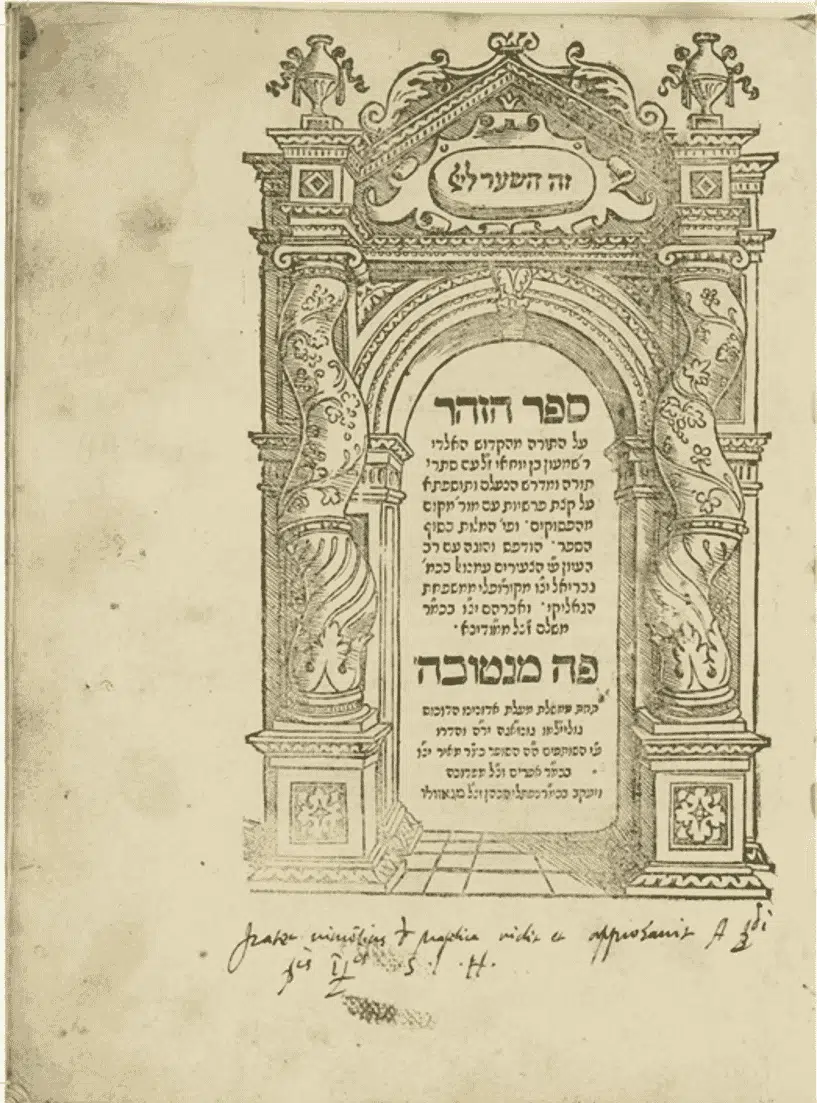
The printing of the Zohar marked both the culmination of a long process of consolidating a literary tradition and the beginning of the struggle to establish it at the heart of Jewish self-identity. At the same time, the elegant portal on its frontispiece can be seen as the threshold and meeting place where Jews and Christians discuss, once again, their shared and hotly contested heritage. The Zohar, with its obscure radiance, had already proven capable of withstanding divergent and even incompatible interpretations.
This article was published in English in *Materia giudaica: rivista dell’associazione italiana per lo studio del giudaismo*: XX/XXI, 2015/2016 – La Giuntina (torrossa.com) under the title“The Zohar among the Christians in the Renaissance,” in *Materia Giudaica* 25 (2020), pp. 511–524.